 2022, Vol. 49
扩展功能

文章信息
- 王海希, 郝志鹏, 张莘, 谢伟, 陈保冬
- WANG Haixi, HAO Zhipeng, ZHANG Xin, XIE Wei, CHEN Baodong
- 丛枝菌根真菌防治尖孢镰孢枯萎病的效应、机制及其应用研究进展
- Effect, mechanisms and application of arbuscular mycorrhizal fungi for biological control of Fusarium oxysporum-caused wilt: a review
- 微生物学通报, 2022, 49(7): 2819-2837
- Microbiology China, 2022, 49(7): 2819-2837
- DOI: 10.13344/j.microbiol.china.211118
-
文章历史
- 收稿日期: 2021-11-25
- 接受日期: 2022-02-06
- 网络首发日期: 2022-03-21


2. 中国科学院大学, 北京 100049
2. University of Chinese Academy of Sciences, Beijing 100049, China
尖孢镰孢(Fusarium oxysporum Snyder & Hansen,即尖孢镰刀菌)是一类既可以侵染植物又能够在土壤中营腐生生活的兼性寄生真菌,其寄主范围广泛,能够危害香蕉[1-2]、番茄[3]、黄瓜[4]和西瓜[5]等100多种植物,被植物病理学界认为是排名前五的真菌病害之一[6]。尖孢镰孢能够以厚垣孢子形式在土壤中保持长期休眠状态,而当土壤温度和湿度适宜时便会萌发侵染[7],并通过风、雨水、灌溉及含有病原物的土壤进行传播[8]。在土壤中,尖孢镰孢能够通过性信息素受体和细胞壁促分裂原活化蛋白激酶通路感知植物分泌的过氧化酶来定位根系[9],从根尖、根系伤口或侧根生长点进入植物体,分泌致病毒素和细胞壁降解酶,损害植物根系细胞膜和维管束系统[10-11],干扰水分运输和营养吸收,导致植物自下而上逐渐枯萎[12]。植株发病时期的典型表现为:发病初期植株底部出现部分黄化现象,逐渐向上发展,表现为中午缺水萎蔫,早晚可恢复正常;后期枯萎症状无法恢复,植物生长停滞,根茎部腐烂变色,植株病变、坏死最终枯萎[13]。剖开发病植株的茎部会发现维管束呈黑褐色,内部充满病原菌菌丝和孢子,成为尖孢镰孢再侵染的繁殖体[14]。
根据侵染对象的差异,尖孢镰孢可分为不同的专化型;不同专化型的致病过程所具有的高度特异性[15-16]是由谱系特异性染色体决定的[17]。这些染色体富含转座子和致病相关基因,易发生基因水平转移,导致尖孢镰孢寄主范围广泛[18-19]。尖孢镰孢较强的存活能力和致病性使得植物尖孢镰孢枯萎病难以防治和管理[20]。控制枯萎病的有效方法主要包括培育抗病品种、利用农业措施及使用化学药剂等[21-24]。但抗病植物品种研发周期长、抗病能力维持时间较短,而土地资源有限、轮作方法不易实施等因素制约了尖孢镰孢枯萎病的防治;化学药剂的不合理施用可能使病原菌产生耐药性[25],影响作物品质和人体健康,并会导致土壤、水体和大气污染等环境问题,严重影响生态系统稳定[26]。因此,探索高效、环保的尖孢镰孢防治措施成为近年来研究的前沿和热点之一[27-30]。生防微生物因具有安全、生态可持续性的特点而广受关注,而且相较于化学防治,采用生物防治也更符合现代生态农业发展的需要[31]。
丛枝菌根(arbuscular mycorrhiza,AM)真菌能通过与宿主植物精确的“分子对话”在根系皮层内定殖并形成特殊的丛枝状结构[32-33],植物为AM真菌提供碳水化合物和脂类物质的同时,AM真菌能够促进植物对土壤中磷(P)等矿质元素的吸收[34],促进植物生长[35-36],并提高植物抵御生物及非生物胁迫的能力[37-40],在改善生态系统稳定性方面也具有重要作用[41-42]。大量研究表明,AM真菌能够协助植物防御线虫、真菌、细菌和病毒的感染,增强植物的抗病能力[43-48]。Hao等[49]研究证实了接种AM真菌幼套近明球囊霉(Glomus etunicatum Walker & Schuessler)能有效防治黄瓜尖孢镰孢枯萎病,降低植株的发病率和病情指数,结果还表明,AM真菌能诱导植株对病原菌的感染做出快速反应,菌根共生体对植株生长的促进作用补偿了病原菌引起的根系损伤。王倡宪等[50]进一步分析了AM真菌对植物根系细胞膜功能和根际(rhizosphere,又称根围)微生物群落组成的影响,探讨了AM真菌在减少尖孢镰孢黄瓜专化型(F. oxysporum f. sp. cucumerinum)感染植株中的作用机制。近年来,AM真菌防治尖孢镰孢枯萎病得到了广泛关注并取得了许多重要成果,本文综述了2001–2021年国内外AM真菌防治尖孢镰孢枯萎病的相关研究进展,包括AM真菌增强植物抵抗尖孢镰孢的效应和作用机制,同时分析了AM真菌和其他手段联合施用防治尖孢镰孢枯萎病的应用,为推进AM真菌生物防治植物病害相关基础与应用研究提供借鉴和参考。
1 AM真菌防治尖孢镰孢枯萎病的研究现状及效应分析为了解国内外AM真菌防治尖孢镰孢枯萎病的研究现状,我们收集整理了2001−2021年的相关研究文献。通过Web of Science (http://apps.webofknowledge.com/)以及中国知网(https://www.cnki.net/)等平台进行文献检索,以“arbuscular mycorrhiza*”和“Fusarium oxysporum”或“丛枝菌根真菌”和“尖孢镰孢” “尖孢镰孢菌” “尖孢镰刀” “尖孢镰刀菌”和“枯萎病”等为关键词,并设置文献类型为“article”或“期刊论文”。文献选择标准为:(1) 采用人工控制试验,并设有合理的重复数量;(2) 施加AM真菌,并设置了不接种的对照处理;(3) 外源接种尖孢镰孢或使用含有尖孢镰孢的土壤(栽培基质);(4) 具有明确的统计分析结果及试验标准差或标准误。基于以上选择标准筛选获得有效文献95篇,我们整理统计了有效文献中试验地点、发表时间、试验条件、宿主植物种类、AM真菌种类和试验处理类型等相关数据信息。
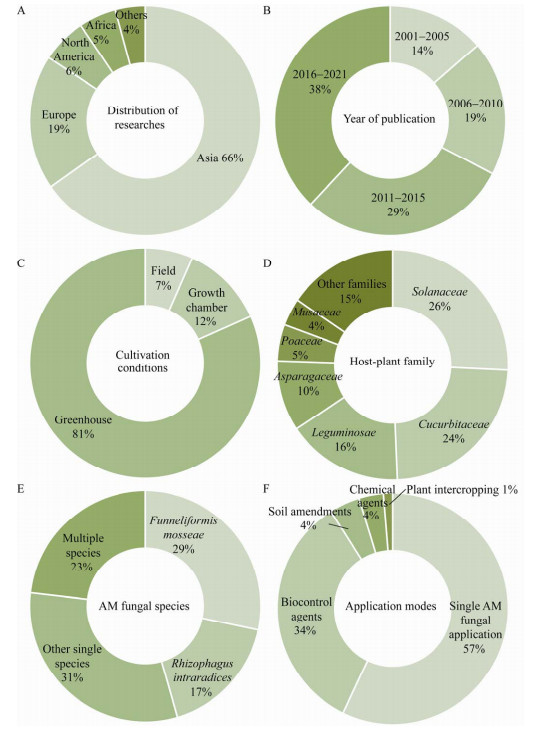
当前AM真菌防治尖孢镰孢枯萎病的相关研究得到了全球范围内的普遍关注(图 1A),尤其是亚洲的国家。近年来,喀麦隆、埃及等非洲国家科研工作者重点针对具有地域特色的乡土植物发表了多篇相关论文。相关研究文献数量呈现逐渐上升的趋势(图 1B),近10年发表的研究论文占研究论文总量的67%,并呈逐年增加的趋势,这说明AM真菌防治尖孢镰孢的研究得到了越来越多的关注,是AM真菌生物防治病害的模式研究体系之一。
|
| 图 1 丛枝菌根真菌防治尖孢镰孢枯萎病研究文献分析 Figure 1 Literature analysis of biological control of Fusarium oxysporum-caused wilt by arbuscular mycorrhizal (AM) fungi. A:研究分布;B:发表时间;C:试验条件;D:宿主植物种类;E:AM真菌种类;F:试验处理类型 A: Distribution of researches; B: Year of publication; C: Cultivation conditions; D: Host-plant family; E: AM fungal species; F: Application modes. |
|
|
相关数据表明大田试验较少,而盆栽模拟实验占样本总数的93% (图 1C),出现这种现象的主要原因可能是盆栽模拟试验相对更易控制和管理,便于研究人员更好地探究病害生物防治的内在机制。
关于宿主植物类型,近年来用于AM真菌研究的植物种类主要集中于茄科(Solanaceae)、葫芦科(Cucurbitaceae)和豆科(Leguminosae),其他种类植物也有部分研究,包括天门冬科(Asparagaceae)、禾本科(Poaceae)和芭蕉科(Musaceae)等(图 1D)。试验中AM真菌的种类主要包括摩西斗管囊霉(Funneliformis mosseae Walker & Schuessler)和根内根孢囊霉(Rhizophagus intraradices Walker & Schuessler) (图 1E),主要因为这两种AM真菌分布广泛,能够在不同研究体系中与宿主植物形成良好的共生关系,促进植物生长的效应也相对比较稳定[51]。此外,相关研究也越来越重视不同AM真菌菌株的适应性差异,混合AM真菌菌剂(23%)也常被用于AM真菌防治尖孢镰孢枯萎病的相关研究[14, 45]。
试验处理方式方面,单一利用AM真菌防治尖孢镰孢枯萎病的试验不到研究案例的60% (图 1F),这表明目前的科学研究已经在研究单一接种AM真菌菌剂防治尖孢镰孢的基础上,将多种手段联合应用以增强防治枯萎病的效果。采用其他手段与AM真菌联合施用防治尖孢镰孢枯萎病的试验中,作为土壤中广泛存在且具有功能多面性的生防微生物受到了科研人员的广泛关注。
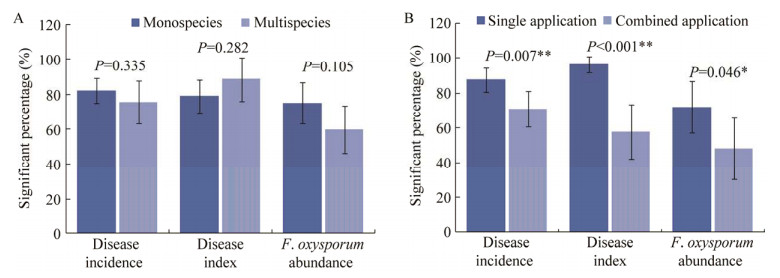
基于已发表的文献数据信息,我们整理了植株发病率、病情指数及尖孢镰孢丰度等表征AM真菌防治尖孢镰孢枯萎病效应的指标,分析了AM真菌菌剂组成和应用方式对AM真菌防治尖孢镰孢作用效果的影响。所得数据通过在线SPSS数据分析软件SPSSAU (V21.0) (https://spssau.com/)进行两独立样本率z检验分析,并计算了数据95%的置信区间[52]。数据结果表明,单接种/混合接种对于防治尖孢镰孢枯萎病(包括植株发病率和病情指数)的作用效果、尖孢镰孢丰度未表现出显著差异(图 2A);而相较于多种手段联合施用,单一施加AM真菌处理对于尖孢镰孢防治的显著比例(significant percentage)更高(图 2B)。这可能是因为目前AM真菌防治尖孢镰孢枯萎病的作用效果已经较为明确,而其他防治手段和AM真菌的联合施用仍处于探索阶段,防治效应具有一定的不稳定性。
|
| 图 2 丛枝菌根真菌菌剂组成(A)和应用方式(B)对尖孢镰孢枯萎病发生、尖孢镰孢丰度的影响 Figure 2 Effects of arbuscular mycorrhizal (AM) fungal inoculum compositions (A) and application modes (B) on Fusarium oxysporum-caused wilt development and the abundance of F. oxysporum. *:P<0.05;**:P<0.01,数据以数值±95%置信区间表示 *: P < 0.05; **: P < 0.01, and the data is expressed as value±95% confidence intervals. |
|
|
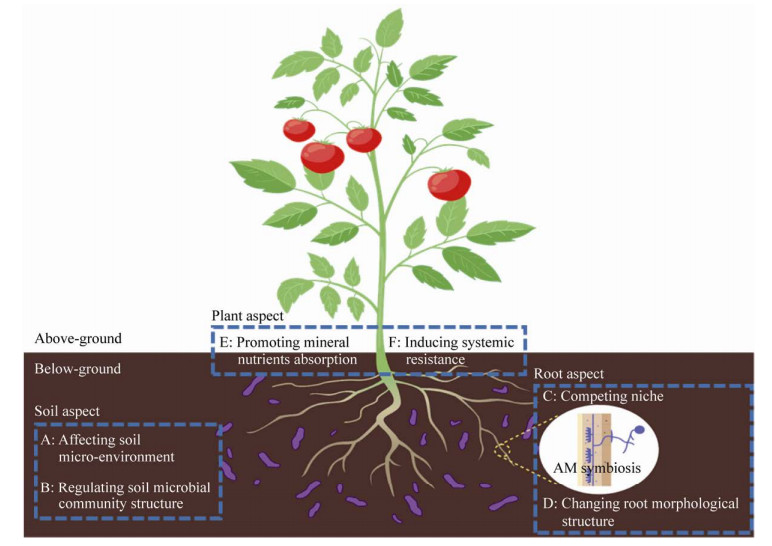
AM真菌防治尖孢镰孢枯萎病是一个较复杂的过程,是多种机制协同作用的结果。根据AM真菌在土壤-植物连续体的空间位置以及影响的范围,可将其归纳为3个主要作用层面,即包含尖孢镰孢的土壤层面、与尖孢镰孢直接接触的根系层面及植株层面(图 3)。这些作用位点既具有区域的独立性,又具备功能的关联性,AM真菌防治尖孢镰孢枯萎病的作用机制存在交叉和相互影响,共同构成了完整的AM真菌防治机制。
|
| 图 3 丛枝菌根真菌防治尖孢镰孢枯萎病的作用机制 Figure 3 Mechanisms of biological control of Fusarium oxysporum-caused wilt by arbuscular mycorrhizal (AM) fungi. |
|
|
当土壤中AM真菌孢子萌发及菌丝伸长时,其产生的分泌物及特殊信号物质等能够影响土壤微环境,还可以影响根系分泌物(糖、有机酸、氨基酸、酚类化合物)的组成和数量,导致土壤物理化学性质发生变化,这些变化是植物应对微生物侵染的一种策略[53]。Ren等[54]通过分析西瓜根系分泌物发现,AM真菌能够提高植株根系分泌的香豆素和苹果酸的浓度,进而减轻尖孢镰孢对植物造成的伤害。Filion等[55]通过离体(in vitro)分室培养系统收集了AM真菌侵染的Ri T-DNA胡萝卜转化毛根的根系分泌物,结果发现添加的菌根化根系分泌物能够抑制尖孢镰孢菊花专化型(F. oxysporum f. sp. chrysanthemi)孢子的萌发,认为AM真菌具有影响土壤中病原菌增殖的潜力。然而,Scheffknecht等[56]研究发现菌根化植株根系分泌物能够促进尖孢镰孢番茄专化型孢子的萌发,而且其萌发率与AM真菌的定殖程度呈正相关关系。这些研究的差异可能与宿主植物的种类、AM真菌的种类及根系分泌物的组成和浓度相关,并且这些研究多关注尖孢镰孢孢子萌发和菌丝生长阶段,而菌根化植株根系分泌物对尖孢镰孢的侵染能力及致病性的影响还有待进一步研究。
2.1.2 调节土壤微生物群落结构AM真菌能够通过直接或者间接途径影响根际微生物的组成。以西瓜[57]、香蕉[58]、番茄[59]和大豆[60]等为目标植物的研究表明,AM真菌能够调节土壤微生物群落结构以降低土壤和根际中尖孢镰孢的丰度。董艳等[61]利用Biolog微平板技术证实了AM真菌能够改善土壤微生物对不同碳源底物的利用能力,进而调节微生物群落结构抑制尖孢镰孢增殖。通过对番茄根系微生物群落的研究分析发现,AM真菌能够提高土壤中细菌和放线菌的数量,进而改善土壤微生物群落结构、增强土壤生态系统的稳定性、降低番茄根际土壤中尖孢镰孢的丰度[59]。Li等[62]也发现接种AM真菌显著提高了土壤中放线菌的丰度、细菌Shannon-Weiner指数及土壤有机质含量,推测AM真菌能够增强土壤微生物与尖孢镰孢的竞争拮抗能力。Hao等[47]证实了从菌根际(mycorrhizosphere)分离的生防细菌类芽孢杆菌(Paenibacillus sp. B2 Ash)及其拮抗物质(paenimyxin)能够高效抑制病原菌的生长和增殖。综上所述,AM真菌能够通过增加土壤微生物的结构和功能来调节土壤生态系统的稳定性,显著降低土壤中尖孢镰孢的丰度。
2.2 根系层面防御机制 2.2.1 与尖孢镰孢竞争生态位AM真菌和尖孢镰孢具有重叠的生态位,二者之间存在的竞争关系主要包括竞争根系侵染位点和植物光合产物两个方面[63]。
AM真菌侵染植物根系后能够占据部分侵染位点,从而减少或者阻止尖孢镰孢的侵染,进而降低宿主植物发病率、病情指数和死亡率。Matsubara等[64]发现AM真菌能够提前侵染芦笋侧根内的短细胞,并在皮层形成数量较多的囊泡和较密的根内菌丝,菌根化植物根系病原菌菌丝数量相对较少,说明AM真菌能够快速占据侵染位点,以降低尖孢镰孢的侵染。
AM真菌和病原菌均为异养生物,二者生长所需要的能量主要来自宿主植物的光合产物。当光合产物被AM真菌利用时,尖孢镰孢的营养来源就会减少,进而影响病原菌的定殖和再侵染。刘东岳等[65]通过镜检发现,变形球囊霉(Glomus versiforme Berch)和摩西斗管囊霉(F. mosseae)能够与尖孢镰孢黄瓜专化型(F. oxysporum f. sp. cucumerinum,Foc)的菌丝紧密接触,通过缠绕、阻挡拮抗等方式与Foc竞争,进而影响病原菌的生长发育,同时,由于AM真菌对于营养物质竞争的增强,导致Foc生长发育受阻、菌丝生长不良。
2.2.2 影响根系形态结构,构建机械保护屏障尖孢镰孢通过入侵和伤害植物根系细胞,进而破坏植物维管束系统导致植物枯萎,因此,根系是植物和病原菌激烈“战斗”的关键部位。菌根化植物的根系皮层细胞壁变厚、细胞层数增加,并且随着细胞壁木质素、纤维素等物质的积累,其根系木质化的程度提高[66]。然而木质素积累造成的机械性强化是阻碍病原菌攻击的有效物理屏障,是增强植株抗病能力的主要机制之一[67]。研究表明,木质素阻隔能够通过减少养分和水分向病原菌转移,影响病原菌的致病因子和细胞壁降解酶的转运,进而抑制病原菌传播[68]。Wang等[69]发现接种摩西斗管囊霉(F. mosseae)能显著提高紫花苜蓿根系木质素的浓度,改善植物抗病性。通过对菌根化番茄根系中差异表达基因(differentially expressed genes,DEGs)进行Kyoto Encyclopedia of Genes and Genomes (KEGG)通路分析,发现木质素相关基因表达显著上调,接种摩西斗管囊霉(F. mosseae)能显著提高番茄根系木质素含量,进而降低了番茄的病情指数[70]。另外,刘东岳等[65]和Ahammed等[71]研究发现AM真菌能够提高宿主植物的根系活力,促进细胞分裂素的产生,降低尖孢镰孢对根系造成的损伤。总之,AM真菌能够通过影响宿主植物根系的细胞生长提高根系活力,促进木质素等物质累积,影响植物根系的生长发育和形态变化,进而提高植物抵抗尖孢镰孢的能力。
2.3 植株层面防御机制 2.3.1 促进宿主植物吸收矿质养分土壤中的AM真菌能够在根外形成庞大的菌丝网络,扩大宿主植物养分的吸收范围,提高宿主植物对矿质养分和水分的吸收能力,促进植物生长,并间接增强了植物抵抗尖孢镰孢的能力[72]。病原菌的入侵会影响植物养分吸收代谢能力,而AM真菌与植物建立起良好的共生关系后,能够在一定程度上补偿尖孢镰孢对植物造成的损害。Li等[62]发现,在应对尖孢镰孢草莓专化型(F. oxysporum f. sp. fragariae)侵染时,AM真菌能够显著提高草莓植物体内大量元素(N、P、K)、中量元素(Ca、Mg)和微量元素(Fe)的含量,提高植物抵抗病原菌的能力。AM真菌防治西瓜枯萎病的研究发现,接种不同类型的AM真菌(F. mosseae、G. versiforme、Gigaspora rosea Nicolson & Schenck)均能够显著提高植物N、P、B、Zn等元素的含量,而且叶片的净光合速率、蒸腾速率、气孔导度和水分利用效率均显著高于不接种AM真菌的对照处理[57]。
研究表明,AM真菌能够促进植物对P的吸收、改善植株的营养状况,进而促进植物生长[73],但植物体内P元素的含量与植物抗病能力之间的关系仍存有争议。研究表明,AM真菌增强植物抗尖孢镰孢的能力在于养分吸收得到增强,在养分适宜、灌溉良好的土壤环境中,AM真菌促进巴西蕉P元素的吸收作用,能够显著提高植株生物量,从而减轻香蕉枯萎病的危害[74]。然而,改善矿质营养(例如P)并非总能解释AM真菌抵御病原菌的防御机制。Toussaint等[75]发现接种AM真菌处理具有病害防治效果,但菌根化植物与未接种植物P元素的含量并无显著差异,认为AM真菌对植物的保护作用并非通过改善植物对P的吸收而实现。相关研究可以通过调节土壤中矿质养分的浓度,使得不接种处理和接种AM真菌处理具有相似的植物养分含量和生物量,进而分析养分介导AM真菌提高植物抗病性的直接和间接作用机制。
2.3.2 诱导植物产生系统性抗性菌根化植物受到病原菌侵染时,AM真菌能够诱导宿主植物产生菌根诱导抗性(mycorrhiza induced resistance,MIR),通过一系列复杂的信号转导和生理生化过程增强植物的防御能力。
AM真菌能够诱导植物合成相关信号物质,调节植物体内多种激素水平,进而影响植物对病原菌的抗性。在防御反应初期,宿主植物能够向根际环境释放信号物质,招募包括AM真菌等在内的有益微生物[76]。独角金内酯(strigolactones,SLs)能够诱导AM真菌菌丝分枝、伸长并侵染植物,促进共生关系的形成[77]。有研究认为,这一过程会被植物视为致病性侵染[78],AM真菌的微生物相关分子模式(microbe-associated molecular patterns,MAMPs)会被宿主植物识别,并诱导植物防御性激素水杨酸(salicylic acid,SA)含量的提高,增强植物系统获得性抗性(systemic acquired resistance,SAR)[79]。AM真菌侵入根系皮层,稳定的菌根共生关系建立后,SAR反应受到抑制,SA含量下降;在病原菌胁迫下,AM真菌能够激活茉莉酸(jasmonic acid,JA)信号通路,调控植物诱导系统性抗性(induced systemic resistance,ISR)反应[80]。越来越多的研究证实,JA所介导的ISR在MIR中起决定性作用[81-83]。Nair等[84]发现AM真菌降低尖孢镰孢对番茄损害的过程中,提高了茉莉酸甲酯(methyl jasmonate,MeJA)含量及JA合成途径脂氧合酶(lipoxygenase,LOX)的活性;而施加JA合成抑制剂水杨酸氢氨酸(salicylhydroxamic acid,SHAM)会导致植物对尖孢镰孢的抗性显著下降。脱落酸(abscisic acid,ABA)能够拮抗SA依赖的防御信号途径,植物累积的ABA能够通过木质部和韧皮部转移到其他部位,进而调节植物ISR响应[85]。另外,Martínez-Medina等[86]研究发现,接种AM真菌能够通过调节甜瓜多种激素(玉米素、吲哚乙酸和ABA)的合成以降低尖孢镰孢对植物造成的损害。
植物受到尖孢镰孢侵染后,体内会产生大量的活性氧,破坏细胞内大分子物质,而AM真菌能够激活植物细胞内抗氧化酶保护系统,上调相关防御基因的表达和转录,降低活性氧和自由基含量,增强植物抵抗尖孢镰孢的能力。李敏等[87]研究发现,变形球囊霉(G. versiforme)能够增强西瓜根系中超氧化物歧化酶(superoxide dismutase,SOD)的活性,提高根系在受到尖孢镰孢浸染时的反应速率。Hao等[49]研究表明,接种G. etunicatum提高了黄瓜多酚氧化酶(polyphenol oxidase,PPO)的活性。还有研究表明,施加AM真菌能够显著增强过氧化物酶(peroxidase,POD)和过氧化氢酶(catalase,CAT)的活性,促进植株体内活性氧的清除,使自由基维持动态平衡[88]。接种AM真菌还能够降低枯萎病发病植株丙二醛(malondialdehyde,MDA)的含量,减轻膜脂过氧化对植物细胞造成的损伤[50]。
苯丙氨酸解氨酶(phenylalanine ammonia-lyase,PAL)是植物苯丙烷类物质代谢途径的关键酶,与酚类化合物、木质素和植保素等次生代谢产物的合成和累积有重要关系。几丁质和葡聚糖均为真菌细胞壁的主要成分,而几丁质酶(chitinase,CHI)和β-1, 3-葡聚糖酶(β-1, 3-glucanase,β-1, 3-GA)等在抵御病害方面也有重要作用。AM真菌能够诱导植物分泌CHI和β-1, 3-GA,在病害发生早期降解尖孢镰孢细胞壁,抑制其孢子萌发和菌丝生长[89]。王倡宪等[90]发现尖孢镰孢黄瓜专化型(F. oxysporum f. sp. cucumerinum)胁迫条件下,接种变形球囊霉(G. versiforme)处理的黄瓜幼苗根系CHI、β-1, 3-GA和PAL被提前诱导表达,而且酶活性与对照相比也显著提高。AM真菌能够上调病害胁迫下西瓜根系CHI编码基因(ClPR4和ClaPR5)、β-1, 3-GA编码基因(ClGlu3)及PAL编码基因(ClPAL4和ClPAL11)的表达量,提高西瓜抵抗枯萎病的能力[91]。
植物次生代谢产物在提高植物自身保护能力和抵御外界不良环境等方面发挥着重要作用[92]。AM真菌能够诱导植物产生萜类、酚类和生物碱等次生代谢产物,增强植物抵抗尖孢镰孢的能力。Eke等[93]研究发现,菜豆内总可溶性酚和黄酮类化合物的含量与枯萎病发病率呈负相关关系,AM真菌能够增加病害胁迫下植物组织内这些次生代谢物质的含量,帮助植物抵御病原菌的侵染。
近年来,转录组学和代谢组学等发展迅速,运用多组学手段能够从分子水平上分析和揭示特定条件下细胞内生理生化变化,研究AM共生体中差异表达基因和系统转录变化[94],有助于进一步探索AM真菌增强植物抵抗尖孢镰孢能力的内在机制。Hao等[46]通过抑制消减杂交技术对AM真菌诱导表达的植物抗性基因进行了高通量筛选,证实了病程相关蛋白PR-10和莽草酸途径合成酶(5-enolpyruvylshikimate-3-phosphate synthase,EPSPS)等在抑制病害发展中具有重要作用。Zhang等[28]通过转录组和蛋白质组学手段对AM真菌共生植物病害高发期差异表达基因和蛋白进行分析,发现AM真菌提高大豆抗性的关键途径与苯丙氨酸代谢、植物激素信号转导、植物-病原体相互作用等途径密切相关。Lu等[95]研究发现接种尖孢镰孢条件下,植株编码PAL、反肉桂酸木合酶(CYP73A)、肉桂酰辅酶A还原酶(cinnamyl-CoA reductase,CCR)和苯基丙乙烯酮异构酶(chalcone isomerase,CHI)的基因表达均上调,而接种摩西斗管囊霉(F. mosseae)处理的植株大豆素和甘氨酸等代谢产物的含量显著增加,说明在病原菌胁迫条件下类黄酮生物合成在AM真菌调控大豆根系防御反应中起重要作用。
Hao等[46]利用分根(split-root)系统对同一植物的两侧根系分别接种AM真菌和病原线虫(Xiphinema index Thorne & Allen),结果表明AM真菌能够降低线虫对另一侧根系的取食,证实了AM真菌诱导植株抗病的系统性作用机制。除此之外,菌根化植物根系之间存在着庞大的菌根菌丝网络(common mycorrhizal network,CMN),能够将个体的共生优势扩展到植物群落层面[96],降低病原菌侵染邻近植物根系的风险。受害植物能够释放挥发性有机物(volatile organic compounds,VOCs)[97]和其他信号物质,通过CMN传递给邻近植物,诱导邻近植物提前响应[98]。目前CMN介导的根系间抗病信号传递的积极作用已在一些病害[99-100]和虫害[101-102]中得到证实,研究发现异形根孢囊霉(R. irregularis)所形成的菌丝网络能够提高马铃薯对致病疫霉(Phytophthora infestans Bary)的抗性,并直接参与预警信号的传递[103]。目前关于植株系统性作用机制及菌丝网络增强植物抵抗尖孢镰孢的相关研究尚未见报道。
3 AM真菌和其他手段联合防治尖孢镰孢枯萎病的应用AM真菌防治尖孢镰孢枯萎病的效果和作用机制已取得了许多重要研究成果,但在实际农业生产中病害的发生情况较为复杂,仅使用AM真菌进行防治可能具有一定的局限性,因此,将AM真菌和其他手段联合应用有助于增强植物抵抗尖孢镰孢的能力。目前主要的联合手段包括与生防生物互作、添加土壤改良剂、施用化学药剂及植物间作等。
3.1 AM真菌与生防生物联合施用生物防治具有绿色、可持续发展的优点,因此,关于AM真菌与土壤动物以及有益微生物联合应用防治尖孢镰孢的研究受到了广泛关注。
蚯蚓作为土壤生态系统的“工程师”,能通过改变微生物群落结构抑制病原菌增殖[104],对土壤健康产生积极影响。研究表明,接种蚯蚓和AM真菌是抵御尖孢镰孢的高效的生防策略,二者具有协同作用,能够降低草莓枯萎病的发病率;二者联合应用的作用机制包括增加植物根系和地上部养分含量,以及提高土壤有机质含量等[62],从而有效抑制尖孢镰孢在土壤中的增殖。
木霉(Trichoderma spp. Pers.)是目前应用最广泛的生防微生物之一,国际上60%的真菌生物生防制剂都含有木霉成分[105]。木霉能通过附着病原菌形成重寄生、分泌拮抗物质及产生水解酶等方式抑制多种病原真菌和细菌[106]。Eke等[107]发现大豆内生哈茨木霉(T. harzianum T8 Rifai)和AM真菌具有协同作用,双接种处理对尖孢镰孢枯萎病的防治效果要好于单接种木霉处理。然而Castillo等[108]研究发现,虽然AM真菌和木霉对香蕉枯萎病均表现出一定的防治效果,但二者联合使用无显著的协同作用,这可能与二者的互作关系,以及与AM真菌种类和土壤营养条件有关[109-110]。De Jaeger等[111]通过离体培养系统和同位素标记手段探究了木霉对AM真菌运输P的影响,推测二者之间可能存在竞争作用,木霉能够通过调节AM真菌与宿主植物之间的源-库关系间接影响AM真菌对植物生长的促进效应。
根瘤菌能够与豆科植物共生形成根瘤,将空气中的分子态N转变为植物可以利用的氨态氮,改善植物氮营养。王晓瑜等[112]研究了接种摩西斗管囊霉(F. mosseae)与苜蓿中华根瘤菌(Sinorhizobium medicae Rome)对紫花苜蓿枯萎病的影响,发现AM真菌能够促进紫花苜蓿根瘤的形成,二者联合施用能够促进苜蓿生长发育和养分吸收,降低了尖孢镰孢枯萎病的发病率。Singh等[113]发现虽然接种AM真菌和根瘤菌均能提高鹰嘴豆P和N的含量,但单一接种AM真菌处理的效果优于联合施用处理。
植物根际促生菌(plant growth promoting rhizobacteria,PGPR)是对植物生长有促进或对病原菌有拮抗作用的根际有益细菌的统称。AM真菌能够与PGPR互作提高植物抵抗尖孢镰孢的能力,共同施加AM真菌和枯草芽孢杆菌(Bacillus subtilis Ehrenberg)对西瓜枯萎病具有较好的防治效果[114]。AM真菌与荧光假单胞菌(Pseudomonas fluorescens Flügge)和贝莱斯芽孢杆菌(B. velezensis Ruiz-García)联合施用均有良好的互作效应,在尖孢镰孢胁迫条件下能够提高黄瓜根系活力和防御酶活性[65]。
3.2 AM真菌与土壤改良剂联合施用土壤改良剂,包括有机物提取物、天然矿物或人工高分子聚合物等,能够通过改良土壤物理、化学和生物性质,使其更适合植物生长[115]。研究表明,AM真菌和泥炭[116]、腐殖酸[117]及生物炭[118]等土壤改良剂相互作用提高植物抵抗尖孢镰孢的能力。Akhter等[53]研究证实了堆肥、木材生物炭、绿废生物炭和AM真菌联合施用能够减轻尖孢镰孢对番茄造成的损害,推测AM真菌与土壤改良剂联合施用的协同机制主要包括改善土壤的物理化学性质、调节植物根系分泌物、改善土壤微生物的活性、影响土壤有益微生物等。
3.3 AM真菌与化学药剂联合施用使用氯化苦等化学药剂对含有病原菌的土壤进行熏蒸处理,能够达到杀死、减少病原菌的效果[119]。齐永志等[120]通过田间原位试验测定了氯化苦熏蒸土壤后接种AM真菌对草莓生长、产量、品质及枯萎病发生情况的影响,结果表明,氯化苦熏蒸土壤能够提高AM真菌的侵染率、增加植物生物量、增强枯萎病的生防效果,AM真菌和化学药剂共同施用在减少化学药剂用量的同时,还可以提高宿主植物的产量和品质,二者联合施用在田间生产中具有一定的推广应用前景。
3.4 AM真菌在间作体系中的应用董艳等[121]研究了间作小麦和接种AM真菌对蚕豆枯萎病的防治效果,证实了二者对降低蚕豆枯萎病发生和促进蚕豆生长均有积极效应,协同提高了根际微生物活性,抑制了尖孢镰孢的增殖。Hage-Ahmed等[122]将韭菜、黄瓜、罗勒和茴香与番茄进行间作,发现韭菜和番茄间作能显著提高AM真菌在根系的侵染,增加了番茄地上部和根系的生物量。因此,选择适宜的菌根化间作体系能够提高AM真菌的侵染率,促进宿主植物生长,提高植物防治尖孢镰孢枯萎病的作用效果。
4 总结与展望综上所述,AM真菌防治尖孢镰孢枯萎病已经取得了许多重要进展,能够在土壤、根系和植株等作用层面发挥生物防治作用,并与生防微生物、土壤改良剂及间作植物等手段联合应用,增强宿主植物抵抗尖孢镰孢的能力,为减少化学农药和肥料的使用提供了一种环境友好的解决途径。目前AM真菌防治尖孢镰孢的相关分子机制及推广应用等方面尚有一些不足。关于AM真菌防治尖孢镰孢的相关机制研究虽然较多,但很多植物的信号转导和代谢响应途径并不清楚,仍需要强化现代分子生物学技术和细胞学技术应用,运用高通量测序和组学手段对其进行系统深入的研究。AM真菌菌丝网络和根际微生物组等研究能够将个体物种水平拓展到群落水平,AM真菌与多种有益微生物及特定化学物质的联合应用,将使得优化枯萎病防治体系成为可能。当前研究多集中在人工控制试验上,还需要更多的田间试验去验证AM真菌防治尖孢镰孢枯萎病的积极作用,并建立包括AM真菌菌剂生产、接种和配套管理等成套技术,保障AM真菌产品的田间应用效果。
| [1] |
Fu L, Penton CR, Ruan YZ, Shen ZZ, Xue C, Li R, Shen QR. Inducing the rhizosphere microbiome by biofertilizer application to suppress banana Fusarium wilt disease[J]. Soil Biology and Biochemistry, 2017, 104: 39-48. DOI:10.1016/j.soilbio.2016.10.008 |
| [2] |
Dale J, James A, Paul JY, Khanna H, Smith M, Peraza-Echeverria S, Garcia-Bastidas F, Kema G, Waterhouse P, Mengersen K, et al. Transgenic Cavendish bananas with resistance to Fusarium wilt tropical race 4[J]. Nature Communications, 2017, 8: 1496. DOI:10.1038/s41467-017-01670-6 |
| [3] |
Constantin ME, Vlieger BV, Takken FLW, Rep M. Diminished pathogen and enhanced endophyte colonization upon coinoculation of endophytic and pathogenic Fusarium strains[J]. Microorganisms, 2020, 8(4): 544. DOI:10.3390/microorganisms8040544 |
| [4] |
Han LJ, Wang ZY, Li N, Wang YH, Feng JT, Zhang X. Bacillus amyloliquefaciens B1408 suppresses Fusarium wilt in cucumber by regulating the rhizosphere microbial community[J]. Applied Soil Ecology, 2019, 136: 55-66. DOI:10.1016/j.apsoil.2018.12.011 |
| [5] |
Lü HF, Cao HS, Nawaz MA, Sohail H, Huang Y, Cheng F, Kong QS, Bie ZL. Wheat intercropping enhances the resistance of watermelon to Fusarium wilt[J]. Frontiers in Plant Science, 2018, 9: 696. DOI:10.3389/fpls.2018.00696 |
| [6] |
Dean R, Van Kan JAL, Pretorius ZA, Hammond-Kosack KE, Di Pietro A, Spanu PD, Rudd JJ, Dickman M, Kahmann R, Ellis J, et al. The Top 10 fungal pathogens in molecular plant pathology[J]. Molecular Plant Pathology, 2012, 13(4): 414-430. DOI:10.1111/j.1364-3703.2011.00783.x |
| [7] |
Fang XL, Kuo J, You MP, Finnegan PM, Barbetti MJ. Comparative root colonisation of strawberry cultivars Camarosa and Festival by Fusarium oxysporum f. sp. fragariae[J]. Plant and Soil, 2012, 358(1/2): 75-89. |
| [8] |
Dita M, Barquero M, Heck D, Mizubuti ESG, Staver CP. Fusarium wilt of banana: current knowledge on epidemiology and research needs toward sustainable disease management[J]. Frontiers in Plant Science, 2018, 9: 1468. DOI:10.3389/fpls.2018.01468 |
| [9] |
Turrà D, El Ghalid M, Rossi F, Di Pietro A. Fungal pathogen uses sex pheromone receptor for chemotropic sensing of host plant signals[J]. Nature, 2015, 527(7579): 521-524. DOI:10.1038/nature15516 |
| [10] |
Bani M, Rispail N, Evidente A, Rubiales D, Cimmino A. Identification of the main toxins isolated from Fusarium oxysporum f. sp. pisi race 2 and their relation with isolates' pathogenicity[J]. Journal of Agricultural and Food Chemistry, 2014, 62(12): 2574-2580. DOI:10.1021/jf405530g |
| [11] |
Islam KT, Bond JP, Fakhoury AM. FvSNF1, the sucrose non-fermenting protein kinase gene of Fusarium virguliforme, is required for cell-wall-degrading enzymes expression and sudden death syndrome development in soybean[J]. Current Genetics, 2017, 63(4): 723-738. DOI:10.1007/s00294-017-0676-9 |
| [12] |
Li CQ, Yang JH, Li WB, Sun JB, Peng M. Direct root penetration and rhizome vascular colonization by Fusarium oxysporum f. sp. cubense are the key steps in the successful infection of Brazil Cavendish[J]. Plant Disease, 2017, 101(12): 2073-2078. DOI:10.1094/PDIS-04-17-0467-RE |
| [13] |
Fravel D, Olivain C, Alabouvette C. Fusarium oxysporum and its biocontrol[J]. New Phytologist, 2003, 157(3): 493-502. DOI:10.1046/j.1469-8137.2003.00700.x |
| [14] |
Gao Y, Li SJ, Zhang SW, Feng T, Zhang ZY, Luo SJ, Mao HY, Borkovich KA, Ouyang SQ. SlymiR482e-3p mediates tomato wilt disease by modulating ethylene response pathway[J]. Plant Biotechnology Journal, 2021, 19(1): 17-19. DOI:10.1111/pbi.13439 |
| [15] |
Fourie G, Steenkamp ET, Ploetz RC, Gordon TR, Viljoen A. Current status of the taxonomic position of Fusarium oxysporum formae specialis cubense within the Fusarium oxysporum complex[J]. Infection, Genetics and Evolution, 2011, 11(3): 533-542. DOI:10.1016/j.meegid.2011.01.012 |
| [16] |
Lombard L, Sandoval-Denis M, Lamprecht SC, Crous PW. Epitypification of Fusarium oxysporum-clearing the taxonomic chaos[J]. Persoonia, 2019, 43: 1-47. DOI:10.3767/persoonia.2019.43.01 |
| [17] |
Ma LJ, Van Der Does HC, Borkovich KA, Coleman JJ, Daboussi MJ, Di Pietro A, Dufresne M, Freitag M, Grabherr M, Henrissat B, et al. Comparative genomics reveals mobile pathogenicity chromosomes in Fusarium[J]. Nature, 2010, 464(7287): 367-373. DOI:10.1038/nature08850 |
| [18] |
Dam PV, Fokkens L, Ayukawa Y, Van Der Gragt M, Ter Horst A, Brankovics B, Houterman PM, Arie T, Rep M. A mobile pathogenicity chromosome in Fusarium oxysporum for infection of multiple cucurbit species[J]. Scientific Reports, 2017, 7: 9042. DOI:10.1038/s41598-017-07995-y |
| [19] |
Czislowski E, Fraser-Smith S, Zander M, O'Neill WT, Meldrum RA, Tran-Nguyen LTT, Batley J, Aitken EAB. Investigation of the diversity of effector genes in the banana pathogen, Fusarium oxysporum f. sp. cubense, reveals evidence of horizontal gene transfer[J]. Molecular Plant Pathology, 2018, 19(5): 1155-1171. DOI:10.1111/mpp.12594 |
| [20] |
Singh VK, Khan AW, Saxena RK, Kumar V, Kale SM, Sinha P, Chitikineni A, Pazhamala LT, Garg V, Sharma M, et al. Next-generation sequencing for identification of candidate genes for Fusarium wilt and sterility mosaic disease in pigeonpea (Cajanus cajan)[J]. Plant Biotechnology Journal, 2016, 14(5): 1183-1194. DOI:10.1111/pbi.12470 |
| [21] |
Zhang M, Liu QL, Yang XP, Xu JH, Liu G, Yao XF, Ren RS, Xu J, Lou LN. CRISPR/Cas9-mediated mutagenesis of Clpsk1 in watermelon to confer resistance to Fusarium oxysporum f. sp. niveum[J]. Plant Cell Reports, 2020, 39(5): 589-595. DOI:10.1007/s00299-020-02516-0 |
| [22] |
Dmitriev AA, Krasnov GS, Rozhmina TA, Novakovskiy RO, Snezhkina AV, Fedorova MS, Yurkevich OY, Muravenko OV, Bolsheva NL, Kudryavtseva AV, et al. Differential gene expression in response to Fusarium oxysporum infection in resistant and susceptible genotypes of flax (Linum usitatissimum L.)[J]. BMC Plant Biology, 2017, 17(Suppl 2): 253. |
| [23] |
Jin X, Wang J, Li DL, Wu FZ, Zhou XG. Rotations with Indian mustard and wild rocket suppressed cucumber Fusarium wilt disease and changed rhizosphere bacterial communities[J]. Microorganisms, 2019, 7(2): 57. DOI:10.3390/microorganisms7020057 |
| [24] |
Shen ZZ, Xue C, Penton CR, Thomashow LS, Zhang N, Wang BB, Ruan YZ, Li R, Shen QR. Suppression of banana Panama disease induced by soil microbiome reconstruction through an integrated agricultural strategy[J]. Soil Biology and Biochemistry, 2019, 128: 164-174. DOI:10.1016/j.soilbio.2018.10.016 |
| [25] |
Kretschmer M, Leroch M, Mosbach A, Walker AS, Fillinger S, Mernke D, Schoonbeek HJ, Pradier JM, Leroux P, De Waard MA, et al. Fungicide-driven evolution and molecular basis of multidrug resistance in field populations of the grey mould fungus Botrytis cinerea[J]. PLoS Pathogens, 2009, 5(12): e1000696. DOI:10.1371/journal.ppat.1000696 |
| [26] |
Bernhardt ES, Rosi EJ, Gessner MO. Synthetic chemicals as agents of global change[J]. Frontiers in Ecology and the Environment, 2017, 15(2): 84-90. DOI:10.1002/fee.1450 |
| [27] |
Zhang XQ, Bai L, Guo N, Cai BY. Transcriptomic analyses revealed the effect of Funneliformis mosseae on genes expression in Fusarium oxysporum[J]. PLoS One, 2020, 15(7): e0234448. DOI:10.1371/journal.pone.0234448 |
| [28] |
Zhang XQ, Bai L, Sun HB, Yang C, Cai BY. Transcriptomic and proteomic analysis revealed the effect of Funneliformis mosseae in soybean roots differential expression genes and proteins[J]. Journal of Proteome Research, 2020, 19(9): 3631-3643. DOI:10.1021/acs.jproteome.0c00017 |
| [29] |
Jamiołkowska A, Michałek W. Effect of mycorrhiza inoculation of pepper seedlings (Capsicum annuum L.) on the growth and protection against Fusarium oxysporum infection[J]. Acta Scientiarum Polonorum Hortorum Cultus, 2019, 18(1): 161-169. DOI:10.24326/asphc.2019.1.16 |
| [30] |
Chialva M, Zhou Y, Spadaro D, Bonfante P. Not only priming: soil microbiota may protect tomato from root pathogens[J]. Plant Signaling & Behavior, 2018, 13(8): e1464855. |
| [31] |
Glare T, Caradus J, Gelernter W, Jackson T, Keyhani N, Köhl J, Marrone P, Morin L, Stewart A. Have biopesticides come of age?[J]. Trends in Biotechnology, 2012, 30(5): 250-258. DOI:10.1016/j.tibtech.2012.01.003 |
| [32] |
Bouwmeester HJ, Roux C, Lopez-Raez JA, Bécard G. Rhizosphere communication of plants, parasitic plants and AM fungi[J]. Trends in Plant Science, 2007, 12(5): 224-230. DOI:10.1016/j.tplants.2007.03.009 |
| [33] |
Bonfante P, Genre A. Mechanisms underlying beneficial plant-fungus interactions in mycorrhizal symbiosis[J]. Nature Communications, 2010, 1: 48. DOI:10.1038/ncomms1046 |
| [34] |
Sawers RJH, Svane SF, Quan C, Grønlund M, Wozniak B, Gebreselassie MN, González-Muñoz E, Chávez Montes RA, Baxter I, Goudet J, et al. Phosphorus acquisition efficiency in arbuscular mycorrhizal maize is correlated with the abundance of root-external hyphae and the accumulation of transcripts encoding PHT1 phosphate transporters[J]. New Phytologist, 2017, 214(2): 632-643. DOI:10.1111/nph.14403 |
| [35] |
Bona E, Cantamessa S, Massa N, Manassero P, Marsano F, Copetta A, Lingua G, D'Agostino G, Gamalero E, Berta G. Arbuscular mycorrhizal fungi and plant growth-promoting pseudomonads improve yield, quality and nutritional value of tomato: a field study[J]. Mycorrhiza, 2017, 27(1): 1-11. DOI:10.1007/s00572-016-0727-y |
| [36] |
Lin JX, Wang YN, Sun SN, Mu CS, Yan XF. Effects of arbuscular mycorrhizal fungi on the growth, photosynthesis and photosynthetic pigments of Leymus chinensis seedlings under salt-alkali stress and nitrogen deposition[J]. Science of the Total Environment, 2017, 576: 234-241. DOI:10.1016/j.scitotenv.2016.10.091 |
| [37] |
Liu L, Li JW, Yue FX, Yan XW, Wang FY, Bloszies S, Wang YF. Effects of arbuscular mycorrhizal inoculation and biochar amendment on maize growth, cadmium uptake and soil cadmium speciation in Cd-contaminated soil[J]. Chemosphere, 2018, 194: 495-503. DOI:10.1016/j.chemosphere.2017.12.025 |
| [38] |
Mathur S, Tomar RS, Jajoo A. Arbuscular mycorrhizal fungi (AMF) protects photosynthetic apparatus of wheat under drought stress[J]. Photosynthesis Research, 2019, 139(1/3): 227-238. |
| [39] |
Ma Y, Rajkumar M, Oliveira RS, Zhang C, Freitas H. Potential of plant beneficial bacteria and arbuscular mycorrhizal fungi in phytoremediation of metal-contaminated saline soils[J]. Journal of Hazardous Materials, 2019, 379: 120813. DOI:10.1016/j.jhazmat.2019.120813 |
| [40] |
Li YY, Zeng JH, Wang SZ, Lin QQ, Ruan DS, Chi HC, Zheng MY, Chao YQ, Qiu RL, Yang YH. Effects of cadmium-resistant plant growth-promoting rhizobacteria and Funneliformis mosseae on the cadmium tolerance of tomato (Lycopersicon esculentum L.)[J]. International Journal of Phytoremediation, 2020, 22(5): 451-458. DOI:10.1080/15226514.2019.1671796 |
| [41] |
Bowles TM, Jackson LE, Loeher M, Cavagnaro TR. Ecological intensification and arbuscular mycorrhizas: a meta-analysis of tillage and cover crop effects[J]. Journal of Applied Ecology, 2017, 54(6): 1785-1793. DOI:10.1111/1365-2664.12815 |
| [42] |
Lin GG, McCormack ML, Ma CG, Guo DL. Similar below-ground carbon cycling dynamics but contrasting modes of nitrogen cycling between arbuscular mycorrhizal and ectomycorrhizal forests[J]. New Phytologist, 2017, 213(3): 1440-1451. DOI:10.1111/nph.14206 |
| [43] |
Steinkellner S, Hage-Ahmed K, García-Garrido JM, Illana A, Ocampo JA, Vierheilig H. A comparison of wild-type, old and modern tomato cultivars in the interaction with the arbuscular mycorrhizal fungus Glomus mosseae and the tomato pathogen Fusarium oxysporum f. sp. lycopersici[J]. Mycorrhiza, 2012, 22(3): 189-194. DOI:10.1007/s00572-011-0393-z |
| [44] |
Khatun S, Chatterjee NC. Glomus fasciculatum in defense responses to fusarial wilt of Coleus forskohlii[J]. Acta Agriculturae Scandinavica, Section B-Soil & Plant Science, 2011, 61(2): 136-142. |
| [45] |
Arici SE, Erdogan O, Tuncel ZN. Natural, environmental and practical biological control options for Fusarium wilt disease of carnation (Fusarium oxysporum f. sp. dianthi)[J]. Applied Ecology and Environmental Research, 2019, 17(6): 15255-15265. |
| [46] |
Hao ZP, Fayolle L, Van Tuinen D, Chatagnier O, Li XL, Gianinazzi S, Gianinazzi-Pearson V. Local and systemic mycorrhiza-induced protection against the ectoparasitic nematode Xiphinema index involves priming of defence gene responses in grapevine[J]. Journal of Experimental Botany, 2012, 63(10): 3657-3672. DOI:10.1093/jxb/ers046 |
| [47] |
Hao ZP, Van Tuinen D, Wipf D, Fayolle L, Chataignier O, Li XL, Chen BD, Gianinazzi S, Gianinazzi-Pearson V, Adrian M. Biocontrol of grapevine aerial and root pathogens by Paenibacillus sp. strain B2 and paenimyxin in vitro and in planta[J]. Biological Control, 2017, 109: 42-50. DOI:10.1016/j.biocontrol.2017.03.004 |
| [48] |
Hao ZP, Van Tuinen D, Fayolle L, Chatagnier O, Li XL, Chen BD, Gianinazzi S, Gianinazzi-Pearson V. Arbuscular mycorrhiza affects Grapevine fanleaf virus transmission by the nematode vector Xiphinema index[J]. Applied Soil Ecology, 2018, 129: 107-111. DOI:10.1016/j.apsoil.2018.05.007 |
| [49] |
Hao ZP, Christie P, Qin L, Wang CX, Li XL. Control of Fusarium wilt of cucumber seedlings by inoculation with an arbuscular mycorrhical fungus[J]. Journal of Plant Nutrition, 2005, 28(11): 1961-1974. DOI:10.1080/01904160500310997 |
| [50] |
Wang CX, Hao ZP. Effects of arbuscular mycorrhizal fungi on fusarium wilt of cucumber seedlings[J]. Mycosystema, 2008, 27(3): 395-404. (in Chinese) 王倡宪, 郝志鹏. 丛枝菌根真菌对黄瓜枯萎病的影响[J]. 菌物学报, 2008, 27(3): 395-404. |
| [51] |
Chen BD, Yu M, Hao ZP, Xie W, Zhang X. Research progress in arbuscular mycorrhizal technology[J]. Chinese Journal of Applied Ecology, 2019, 30(3): 1035-1046. (in Chinese) 陈保冬, 于萌, 郝志鹏, 谢伟, 张莘. 丛枝菌根真菌应用技术研究进展[J]. 应用生态学报, 2019, 30(3): 1035-1046. |
| [52] |
Berruti A, Lumini E, Balestrini R, Bianciotto V. Arbuscular mycorrhizal fungi as natural biofertilizers: let's benefit from past successes[J]. Frontiers in Microbiology, 2016, 6: 1559. |
| [53] |
Akhter A, Hage-Ahmed K, Soja G, Steinkellner S. Compost and biochar alter mycorrhization, tomato root exudation, and development of Fusarium oxysporum f. sp. lycopersici[J]. Frontiers in Plant Science, 2015, 6: 529. |
| [54] |
Ren LX, Zhang N, Wu P, Huo HW, Xu GH, Wu GP. Arbuscular mycorrhizal colonization alleviates Fusarium wilt in watermelon and modulates the composition of root exudates[J]. Plant Growth Regulation, 2015, 77(1): 77-85. DOI:10.1007/s10725-015-0038-x |
| [55] |
Filion M, St-Arnaud M, Fortin JA. Direct interaction between the arbuscular mycorrhizal fungus Glomus intraradices and different rhizosphere microorganisms[J]. New Phytologist, 1999, 141(3): 525-533. DOI:10.1046/j.1469-8137.1999.00366.x |
| [56] |
Scheffknecht S, Mammerler R, Steinkellner S, Vierheilig H. Root exudates of mycorrhizal tomato plants exhibit a different effect on microconidia germination of Fusarium oxysporum f. sp. lycopersici than root exudates from non-mycorrhizal tomato plants[J]. Mycorrhiza, 2006, 16(5): 365-370. DOI:10.1007/s00572-006-0048-7 |
| [57] |
Li M, Liu RJ, Li XL. Influences of arbuscular mycorrhizal fungi on growth and Fusarium wilt disease of watermelon in field[J]. Acta Phytopathologica Sinica, 2004, 34(5): 472-473. (in Chinese) 李敏, 刘润进, 李晓林. 大田条件下丛枝菌根真菌对西瓜生长和枯萎病的影响[J]. 植物病理学报, 2004, 34(5): 472-473. DOI:10.3321/j.issn:0412-0914.2004.05.015 |
| [58] |
Mohandas S, Manjula R, Rawal RD, Lakshmikantha HC, Chakraborty S, Ramachandra YL. Evaluation of arbuscular mycorrhiza and other biocontrol agents in managing Fusarium oxysporum f. sp. Cubense infection in banana cv. Neypoovan[J]. Biocontrol Science and Technology, 2010, 20(2): 165-181. DOI:10.1080/09583150903438439 |
| [59] |
Ren LX, Lou YS, Sakamoto K, Inubushi K, Amemiya Y, Shen QR, Xu GH. Effects of arbuscular mycorrhizal colonization on microbial community in rhizosphere soil and Fusarium wilt disease in tomato[J]. Communications in Soil Science and Plant Analysis, 2010, 41(11): 1399-1410. DOI:10.1080/00103621003760765 |
| [60] |
Jie WG, Yu WJ, Cai BY. Research on the relationship between Funneliformis mosseae and the root rot pathogen Fusarium oxysporum in the continuous cropping of soybean[J]. Soybean Science, 2016, 35(4): 637-642. (in Chinese) 接伟光, 于文杰, 蔡柏岩. 摩西管柄囊霉与连作大豆根腐病原菌尖孢镰刀菌的相互关系研究[J]. 大豆科学, 2016, 35(4): 637-642. |
| [61] |
Dong Y, Dong K, Yang ZX, Tang L, Zheng Y. Rhizosphere microbial impacts of alleviating faba bean Fusarium wilt with inoculating AM fungi[J]. Chinese Journal of Applied Ecology, 2016, 27(12): 4029-4038. (in Chinese) 董艳, 董坤, 杨智仙, 汤利, 郑毅. AM真菌控制蚕豆枯萎病发生的根际微生物效应[J]. 应用生态学报, 2016, 27(12): 4029-4038. |
| [62] |
Li N, Wang C, Li XL, Liu ML. Effects of earthworms and arbuscular mycorrhizal fungi on preventing Fusarium oxysporum infection in the strawberry plant[J]. Plant and Soil, 2019, 443(1/2): 139-153. |
| [63] |
Larsen J, Johansen A, Erik Larsen S, Henrik Heckmann L, Jakobsen I, Henning Krogh P. Population performance of collembolans feeding on soil fungi from different ecological niches[J]. Soil Biology and Biochemistry, 2008, 40(2): 360-369. DOI:10.1016/j.soilbio.2007.08.016 |
| [64] |
Matsubara Y, Ohba N, Fukui H. Effect of arbuscular mycorrhizal fungus infection on the incidence of Fusarium root rot in Asparagus seedlings[J]. Journal of the Japanese Society for Horticultural Science, 2001, 70(2): 202-206. DOI:10.2503/jjshs.70.202 |
| [65] |
Liu DY, Li M, Sun WX, Liu RJ. Mechanism of increasing resistance of cucumber plants to Fusarium wilt disease by combined inoculation with arbuscular mycorrhizal fungi and plant growth-promoting rhizobacteria[J]. Acta Phytopathologica Sinica, 2017, 47(6): 832-841. (in Chinese) 刘东岳, 李敏, 孙文献, 刘润进. AMF+PGPR组合提高黄瓜抗枯萎病的作用机制[J]. 植物病理学报, 2017, 47(6): 832-841. |
| [66] |
Liu F, Xu YJ, Wang HQ, Zhou Y, Cheng BJ, Li XY. APETALA 2 transcription factor CBX1 is a regulator of mycorrhizal symbiosis and growth of Lotus japonicus[J]. Plant Cell Reports, 2020, 39(4): 445-455. DOI:10.1007/s00299-019-02501-2 |
| [67] |
Ardebili ZO, Ardebili NO, Hamdi SMM. Physiological effects of Pseudomonas fluorescens CHA0 on tomato (Lycopersicon esculentum Mill.) plants and its possible impact on Fusarium oxysporum f. sp. lycopersici[J]. Australian Journal of Crop Science, 2011, 5(12): 1631-1638. |
| [68] |
Smith AH, Gill WM, Pinkard EA, Mohammed CL. Anatomical and histochemical defence responses induced in juvenile leaves of Eucalyptus globulus and Eucalyptus nitens by Mycosphaerella infection[J]. Forest Pathology, 2007, 37(6): 361-373. DOI:10.1111/j.1439-0329.2007.00502.x |
| [69] |
Wang X, Ding T, Li Y, Guo Y, Li Y, Duan T. Dual inoculation of alfalfa (Medicago sativa L.) with Funnelliformis mosseae and Sinorhizobium medicae can reduce Fusarium wilt[J]. Journal of Applied Microbiology, 2020, 129(3): 665-679. DOI:10.1111/jam.14645 |
| [70] |
Chialva M, Salvioli Di Fossalunga A, Daghino S, Ghignone S, Bagnaresi P, Chiapello M, Novero M, Spadaro D, Perotto S, Bonfante P. Native soils with their microbiotas elicit a state of alert in tomato plants[J]. New Phytologist, 2018, 220(4): 1296-1308. DOI:10.1111/nph.15014 |
| [71] |
Ahammed GJ, Mao Q, Yan YR, Wu MJ, Wang YQ, Ren JJ, Guo P, Liu AR, Chen SC. Role of melatonin in arbuscular mycorrhizal fungi-induced resistance to Fusarium wilt in cucumber[J]. Phytopathology, 2020, 110(5): 999-1009. DOI:10.1094/PHYTO-11-19-0435-R |
| [72] |
Smith SE, Jakobsen I, Grønlund M, Smith FA. Roles of arbuscular mycorrhizas in plant phosphorus nutrition: interactions between pathways of phosphorus uptake in arbuscular mycorrhizal roots have important implications for understanding and manipulating plant phosphorus acquisition[J]. Plant Physiology, 2011, 156(3): 1050-1057. DOI:10.1104/pp.111.174581 |
| [73] |
Ferrol N, Azcón-Aguilar C, Pérez-Tienda J. Review: arbuscular mycorrhizas as key players in sustainable plant phosphorus acquisition: an overview on the mechanisms involved[J]. Plant Science, 2019, 280: 441-447. DOI:10.1016/j.plantsci.2018.11.011 |
| [74] |
Liang CC, Liu L, Guo LJ, Yang LY, Wang GF, Zhang JH, Huang JS. Effects of three arbuscular mycorrhizal fungi on Fusarium wilt of banana[J]. Chinese Journal of Tropical Crops, 2015, 36(4): 731-736. (in Chinese) 梁昌聪, 刘磊, 郭立佳, 杨腊英, 王国芬, 张建华, 黄俊生. 球囊霉属3种AM真菌对香蕉枯萎病的影响[J]. 热带作物学报, 2015, 36(4): 731-736. DOI:10.3969/j.issn.1000-2561.2015.04.016 |
| [75] |
Toussaint JP, Kraml M, Nell M, Smith SE, Smith FA, Steinkellner S, Schmiderer C, Vierheilig H, Novak J. Effect of Glomus mosseaeon on concentrations of rosmarinic and caffeic acids and essential oil compounds in basil inoculated with Fusarium oxysporum f. sp. basilici[J]. Plant Pathology, 2008, 57(6): 1109-1116. DOI:10.1111/j.1365-3059.2008.01895.x |
| [76] |
Liu HW, Li JY, Carvalhais LC, Percy CD, Prakash Verma J, Schenk PM, Singh BK. Evidence for the plant recruitment of beneficial microbes to suppress soil-borne pathogens[J]. The New Phytologist, 2021, 229(5): 2873-2885. DOI:10.1111/nph.17057 |
| [77] |
Steinkellner S, Lendzemo V, Langer I, Schweiger P, Khaosaad T, Toussaint JP, Vierheilig H. Flavonoids and strigolactones in root exudates as signals in symbiotic and pathogenic plant-fungus interactions[J]. Molecules: Basel, Switzerland, 2007, 12(7): 1290-1306. DOI:10.3390/12071290 |
| [78] |
Group PA, Conrath U, Beckers GJM, Flors V, García-Agustín P, Jakab G, Mauch F, Newman MA, Pieterse CMJ, Poinssot B, et al. Priming: getting ready for battle[J]. Molecular Plant-Microbe Interactions: MPMI, 2006, 19(10): 1062-1071. DOI:10.1094/MPMI-19-1062 |
| [79] |
Pozo MJ, Azcón-Aguilar C. Unraveling mycorrhiza-induced resistance[J]. Current Opinion in Plant Biology, 2007, 10(4): 393-398. DOI:10.1016/j.pbi.2007.05.004 |
| [80] |
Cameron DD, Neal AL, Van Wees SCM, Ton J. Mycorrhiza-induced resistance: more than the sum of its parts?[J]. Trends in Plant Science, 2013, 18(10): 539-545. DOI:10.1016/j.tplants.2013.06.004 |
| [81] |
Formenti L, Rasmann S. Mycorrhizal fungi enhance resistance to herbivores in tomato plants with reduced jasmonic acid production[J]. Agronomy, 2019, 9(3): 131. DOI:10.3390/agronomy9030131 |
| [82] |
Nair A, Kolet SP, Thulasiram HV, Bhargava S. Systemic jasmonic acid modulation in mycorrhizal tomato plants and its role in induced resistance against Alternaria alternata[J]. Plant Biology: Stuttgart, Germany, 2015, 17(3): 625-631. DOI:10.1111/plb.12277 |
| [83] |
Qu LY, Wang MG, Biere A. Interactive effects of mycorrhizae, soil phosphorus, and light on growth and induction and priming of defense in Plantago lanceolata[J]. Frontiers in Plant Science, 2021, 12: 647372. DOI:10.3389/fpls.2021.647372 |
| [84] |
Nair A, Kolet SP, Thulasiram HV, Bhargava S. Role of methyl jasmonate in the expression of mycorrhizal induced resistance against Fusarium oxysporum in tomato plants[J]. Physiological and Molecular Plant Pathology, 2015, 92: 139-145. DOI:10.1016/j.pmpp.2015.10.002 |
| [85] |
Ton J, Flors V, Mauch-Mani B. The multifaceted role of ABA in disease resistance[J]. Trends in Plant Science, 2009, 14(6): 310-317. DOI:10.1016/j.tplants.2009.03.006 |
| [86] |
Martínez-Medina A, Pascual JA, Pérez-Alfocea F, Albacete A, Roldán A. Trichoderma harzianum and Glomus intraradices modify the hormone disruption induced by Fusarium oxysporum infection in melon plants[J]. Phytopathology, 2010, 100(7): 682-688. DOI:10.1094/PHYTO-100-7-0682 |
| [87] |
Li M, Liu RJ, Zhao HH. Effects of arbuscular mycorrhizal fungi and Fusarium oxysporum f. sp. niveum on enzyme activities in watermelon roots[J]. Mycosystema, 2001, 20(4): 547-551. (in Chinese) 李敏, 刘润进, 赵洪海. AM真菌和镰刀菌对西瓜根系几种酶活性的影响[J]. 菌物系统, 2001, 20(4): 547-551. DOI:10.3969/j.issn.1672-6472.2001.04.020 |
| [88] |
Tayal P, Kapoor R, Bhatnagar A. Functional synergism among Glomus fasciculatum, Trichoderma viride and Pseudomonas fluorescens on Fusarium wilt in tomato[J]. Journal of Plant Pathology, 2011, 93: 745-750. |
| [89] |
Costa MD, Lovato PE, Sete PB. Mycorrhizal inoculation and induction of chitinases and β-1, 3-glucanases and Fusarium resistance in grapevine rootstock[J]. Pesquisa Agropecuaria Brasileira, 2010, 45(4): 376-383. DOI:10.1590/S0100-204X2010000400005 |
| [90] |
Wang CX, Li XL, Song FQ, Wang GQ, Li BQ. Effects of arbuscular mycorrhizal fungi on Fusarium wilt and disease resistance-related enzyme activity in cucumber seedling root[J]. Chinese Journal of Eco-Agriculture, 2012, 20(1): 53-57. (in Chinese) 王倡宪, 李晓林, 宋福强, 王贵强, 李北齐. 两种丛枝菌根真菌对黄瓜苗期枯萎病的防效及根系抗病相关酶活性的影响[J]. 中国生态农业学报, 2012, 20(1): 53-57. |
| [91] |
Li SJ, Wang BS, Wang Y, Zhang SH, Zhang XW, Zhang XH, Xu GH, Ren LX. Mechanism of inoculation of watermelon seedlings with arbuscular mycorrhizae alleviating Fusarium wilt disease[J]. Acta Pedologica Sinica, 2021, 58(3): 744-754. (in Chinese) 李淑君, 王兵爽, 王媛, 张舒桓, 张夕雯, 张晓晖, 徐国华, 任丽轩. 丛枝菌根育苗缓解西瓜枯萎病的机制[J]. 土壤学报, 2021, 58(3): 744-754. |
| [92] |
Hu L, Robert CAM, Cadot S, Zhang X, Ye M, Li B, Manzo D, Chervet N, Steinger T, Van Der Heijden MGA, et al. Root exudate metabolites drive plant-soil feedbacks on growth and defense by shaping the rhizosphere microbiota[J]. Nature Communications, 2018, 9: 2738. DOI:10.1038/s41467-018-05122-7 |
| [93] |
Eke P, Chatue Chatue G, Wakam LN, Kouipou RMT, Fokou PVT, Boyom FF. Mycorrhiza consortia suppress the Fusarium root rot (Fusarium solani f. sp. Phaseoli) in common bean (Phaseolus vulgaris L.)[J]. Biological Control, 2016, 103: 240-250. DOI:10.1016/j.biocontrol.2016.10.001 |
| [94] |
Wang Z, Gerstein M, Snyder M. RNA-Seq: a revolutionary tool for transcriptomics[J]. Nature Reviews Genetics, 2009, 10(1): 57-63. DOI:10.1038/nrg2484 |
| [95] |
Lu CC, Guo N, Yang C, Sun HB, Cai BY. Transcriptome and metabolite profiling reveals the effects of Funneliformis mosseae on the roots of continuously cropped soybeans[J]. BMC Plant Biology, 2020, 20(1): 479. DOI:10.1186/s12870-020-02647-2 |
| [96] |
Kadam SB, Pable AA, Barvkar VT. Mycorrhiza induced resistance (MIR): a defence developed through synergistic engagement of phytohormones, metabolites and rhizosphere[J]. Functional Plant Biology: FPB, 2020, 47(10): 880-890. DOI:10.1071/FP20035 |
| [97] |
Dicke M, Van Loon JJA, Soler R. Chemical complexity of volatiles from plants induced by multiple attack[J]. Nature Chemical Biology, 2009, 5(5): 317-324. DOI:10.1038/nchembio.169 |
| [98] |
Baldwin IT, Halitschke R, Paschold A, Von Dahl CC, Preston CA. Volatile signaling in plant-plant interactions: "talking trees" in the genomics era[J]. Science, 2006, 311(5762): 812-815. DOI:10.1126/science.1118446 |
| [99] |
Xie LJ, Song YY, Zeng RS, Wang RL, Wei XC, Ye M, Hu L, Zhang H. Disease resistance signal transfer between roots of different tomato plants through common arbuscular mycorrhiza networks[J]. Chinese Journal of Applied Ecology, 2012, 23(5): 1145-1152. (in Chinese) 谢丽君, 宋圆圆, 曾任森, 王瑞龙, 魏晓晨, 叶茂, 胡林, 张晖. 丛枝菌根菌丝桥介导的番茄植株根系间抗病信号的传递[J]. 应用生态学报, 2012, 23(5): 1145-1152. |
| [100] |
Song YY, Zeng RS, Xu JF, Li J, Shen X, Yihdego WG. Interplant communication of tomato plants through underground common mycorrhizal networks[J]. PLoS One, 2010, 5(10): e13324. DOI:10.1371/journal.pone.0013324 |
| [101] |
Lin YB, Liu TT, Xue RR, Wu L, Zeng RS, Song YY. Transfer of systemic signaling of insect resistance between roots of tomato plant through arbuscular mycorrhizal networks[J]. Journal of Fujian Agriculture and Forestry University: Natural Science Edition, 2018, 47(5): 547-553. (in Chinese) 林熠斌, 刘婷婷, 薛蓉蓉, 吴磊, 曾任森, 宋圆圆. 丛枝菌根菌丝网络介导的番茄植株根系间抗虫系统性信号的传递[J]. 福建农林大学学报(自然科学版), 2018, 47(5): 547-553. |
| [102] |
Babikova Z, Gilbert L, Bruce TJA, Birkett M, Caulfield JC, Woodcock C, Pickett JA, Johnson D. Underground signals carried through common mycelial networks warn neighbouring plants of aphid attack[J]. Ecology Letters, 2013, 16(7): 835-843. DOI:10.1111/ele.12115 |
| [103] |
Alaux PL, Naveau F, Declerck S, Cranenbrouck S. Common mycorrhizal network induced JA/ET genes expression in healthy potato plants connected to potato plants infected by Phytophthora infestans[J]. Frontiers in Plant Science, 2020, 11: 602. DOI:10.3389/fpls.2020.00602 |
| [104] |
Blouin M, Hodson ME, Delgado EA, Baker G, Brussaard L, Butt KR, Dai J, Dendooven L, Peres G, Tondoh JE, et al. A review of earthworm impact on soil function and ecosystem services[J]. European Journal of Soil Science, 2013, 64(2): 161-182. DOI:10.1111/ejss.12025 |
| [105] |
Wonglom P, Ito SI, Sunpapao A. Volatile organic compounds emitted from endophytic fungus Trichoderma asperellum T1 mediate antifungal activity, defense response and promote plant growth in lettuce (Lactuca sativa)[J]. Fungal Ecology, 2020, 43: 100867. DOI:10.1016/j.funeco.2019.100867 |
| [106] |
Harman GE, Howell CR, Viterbo A, Chet I, Lorito M. Trichoderma species-opportunistic, avirulent plant symbionts[J]. Nature Reviews Microbiology, 2004, 2(1): 43-56. DOI:10.1038/nrmicro797 |
| [107] |
Eke P, Wakam LN, Fokou PVT, Ekounda TV, Sahu KP, Kamdem Wankeu TH, Boyom FF. Improved nutrient status and Fusarium root rot mitigation with an inoculant of two biocontrol fungi in the common bean (Phaseolus vulgaris L.)[J]. Rhizosphere, 2019, 12: 100172. DOI:10.1016/j.rhisph.2019.100172 |
| [108] |
Castillo AG, Puig CG, Cumagun CJR. Non-synergistic effect of Trichoderma harzianum and Glomus spp. in reducing infection of Fusarium wilt in banana[J]. Pathogens: Basel, Switzerland, 2019, 8(2): 43. |
| [109] |
Martínez-Medina A, Pascual JA, Lloret E, Roldán A. Interactions between arbuscular mycorrhizal fungi and Trichoderma harzianum and their effects on Fusarium wilt in melon plants grown in seedling nurseries[J]. Journal of the Science of Food and Agriculture, 2009, 89(11): 1843-1850. DOI:10.1002/jsfa.3660 |
| [110] |
Martínez-Medina A, Roldán A, Pascual JA. Interaction between arbuscular mycorrhizal fungi and Trichoderma harzianum under conventional and low input fertilization field condition in melon crops: growth response and Fusarium wilt biocontrol[J]. Applied Soil Ecology, 2011, 47(2): 98-105. DOI:10.1016/j.apsoil.2010.11.010 |
| [111] |
De Jaeger N, De La Providencia IE, Dupré De Boulois H, Declerck S. Trichoderma harzianum might impact phosphorus transport by arbuscular mycorrhizal fungi[J]. FEMS Microbiology Ecology, 2011, 77(3): 558-567. DOI:10.1111/j.1574-6941.2011.01135.x |
| [112] |
Wang XY, Ding TT, Li YZ, Duan TY. Effects of an arbuscular mycorrhizal fungus and a rhizobium species on Medicago sativa wilt and Fusarium oxysporum root rot[J]. Acta Prataculturae Sinica, 2019, 28(8): 139-149. (in Chinese) 王晓瑜, 丁婷婷, 李彦忠, 段廷玉. AM真菌与根瘤菌对紫花苜蓿镰刀菌萎蔫和根腐病的影响[J]. 草业学报, 2019, 28(8): 139-149. |
| [113] |
Singh PK, Singh M, Vyas D. Biocontrol of Fusarium wilt of chickpea using arbuscular mycorrhizal fungi and Rhizobium leguminosorum biovar[J]. Caryologia, 2010, 63(4): 349-353. DOI:10.1080/00087114.2010.10589745 |
| [114] |
Jiang HY. Control effect of arbuscular mycorrhizal fungi and Bacillus subtilis on Fusarium wilt of watermelon[J]. Northern Horticulture, 2016(24): 124-127. (in Chinese) 姜海燕. AM真菌和枯草芽孢杆菌对西瓜枯萎病的防效[J]. 北方园艺, 2016(24): 124-127. |
| [115] |
Haider G, Steffens D, Moser G, Müller C, Kammann CI. Biochar reduced nitrate leaching and improved soil moisture content without yield improvements in a four-year field study[J]. Agriculture, Ecosystems & Environment, 2017, 237: 80-94. |
| [116] |
Gilardi G, Demarchi S, Gullino ML, Garibaldi A. Evaluation of the short term effect of nursery treatments with phosphite-based products, acibenzolar-S-methyl, pelleted Brassica carinata and biocontrol agents, against lettuce and cultivated rocket Fusarium wilt under artificial inoculation and greenhouse conditions[J]. Crop Protection, 2016, 85: 23-32. DOI:10.1016/j.cropro.2016.03.011 |
| [117] |
Sensoy S, Ocak E, Demir S, Tufenkci S. Effects of humic acid, whey and arbuscular mycorrhizal fungi (AMF) applications on seedling growth and Fusarium wilt in Zucchini (Cucurbita pepo L.)[J]. The Journal of Animal & Plant Sciences, 2013, 23(2): 507-513. |
| [118] |
Elmer WH, Pignatello JJ. Effect of biochar amendments on mycorrhizal associations and Fusarium crown and root rot of Asparagus in replant soils[J]. Plant Disease, 2011, 95(8): 960-966. DOI:10.1094/PDIS-10-10-0741 |
| [119] |
Martin FN, Bull CT. Biological approaches for control of root pathogens of strawberry[J]. Phytopathology, 2002, 92(12): 1356-1362. DOI:10.1094/PHYTO.2002.92.12.1356 |
| [120] |
Qi YZ, Jin JJ, Zhang XJ, Chang N, Zhen WC. Control effect of arbuscular mycorrhizal fungi and chloropicrin on continuous cropping obstacle of strawberry (Fragaria ananassa Duch)[J]. Agrochemicals, 2016, 55(4): 300-303. (in Chinese) 齐永志, 金京京, 张雪娇, 常娜, 甄文超. 丛枝菌根真菌与氯化苦配施对草莓连作障碍的防控作用[J]. 农药, 2016, 55(4): 300-303. |
| [121] |
Dong Y, Zhao Q, Lü JX, Dong K. Synergistic effects of intercropping with wheat and inoculation with arbuscular mycorrhizal fungi on improvement of anti-Fusarium wilt and rhizosphere microbial carbon metabolic activity of faba bean[J]. Journal of Plant Nutrition and Fertilizers, 2019, 25(10): 1646-1656. (in Chinese) 董艳, 赵骞, 吕家兴, 董坤. 间作小麦和接种AM真菌协同提高蚕豆抗枯萎病能力和根际微生物碳代谢活性[J]. 植物营养与肥料学报, 2019, 25(10): 1646-1656. DOI:10.11674/zwyf.18400 |
| [122] |
Hage-Ahmed K, Moyses A, Voglgruber A, Hadacek F, Steinkellner S. Alterations in root exudation of intercropped tomato mediated by the arbuscular mycorrhizal fungus Glomus mosseae and the soilborne pathogen Fusarium oxysporum f. sp. lycopersici[J]. Journal of Phytopathology, 2013, 161(11/12): 763-773. |