 2022, Vol. 49
扩展功能

文章信息
- 邱薇, 刘磊, 康杰, 叶泽铭, 葛菁萍
- QIU Wei, LIU Lei, KANG Jie, YE Zeming, GE Jingping
- 假单胞菌属双组分信号转导系统调控吩嗪生物合成研究进展
- Research progress on phenazine biosynthesis regulated by two-component signal transduction system of Pseudomonas aeruginosa
- 微生物学通报, 2022, 49(1): 352-362
- Microbiology China, 2022, 49(1): 352-362
- DOI: 10.13344/j.microbiol.china.210413
-
文章历史
- 收稿日期: 2021-05-10
- 接受日期: 2021-07-08
- 网络首发日期: 2021-09-07


2. 黑龙江大学生命科学学院 微生物省高校重点实验室,黑龙江 哈尔滨 150080
2. Key Laboratory of Microbiology, College of Heilongjiang Province, School of Life Sciences, Heilongjiang University, Harbin 150080, Heilongjiang, China
土壤是农业发展的基石,土壤质量的优劣关系到整个农业的健康发展[1]。化学农药的不合理使用是影响土壤质量的重要因素。虽然化学农药在治疗农作物真菌性病害方面具有适应面广、操作简单、经济效益高等优点,但化学农药的不合理使用已经威胁到人类的健康,同时降低了土壤肥力,并且对生态环境也会造成污染,这与我国可持续发展的基本国策相悖[2-3]。因此,人们将眼光聚焦于生物农药[4],使用绿色生物制剂促进绿色植物的生长,确保土地的可持续利用[5]。
吩嗪类化合物是具有广谱抑菌活性的细菌次级代谢产物,自20世纪30年代被报道以来,受到了科学家们极大的关注,并开展了大量的研究。研究人员发现吩嗪能很好地抑制某些植物病害,如黄瓜炭疽病、辣椒疫霉病、番茄早疫病等[6-7]。近几年的研究显示,吩嗪作为氧化还原型抗生素,可提高土壤中磷的有效性[8],这些足以证明吩嗪与土壤健康息息相关。
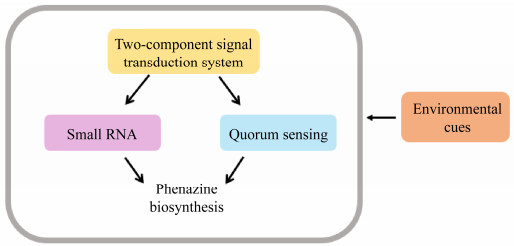
吩嗪的生物合成通常受内源因素和外源因素的影响,内源因素主要指基因水平调控[9],外源因素主要指环境因子[10]。虽然不同的假单胞菌具有不同的菌株特性,但在调控吩嗪类化合物合成方面存在一定共性,主要包括双组分信号转导系统(two-component signal transduction system,TCS)、群体感应系统(quorum sensing,QS)、转录后调控、环境因素影响等,它们之间的关系如图 1所示。本文主要介绍在多数产吩嗪的假单胞菌中表现出来的级联反应调控系统组成。
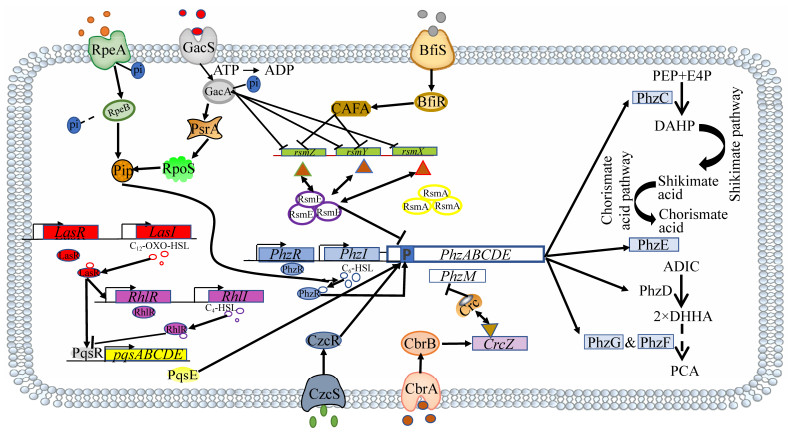
假单胞菌是最先被证明可以产生吩嗪类化合物的菌株[12],大多数假单胞菌都可以生成多种吩嗪类化合物。通常,吩嗪类化合物会首先生成前体物质吩嗪-1-羧酸(penazine-1- carboxylic acid,PCA),然后再通过修饰基因的作用转化为其他的吩嗪类化合物[13]。许多年前,科学家发现吩嗪类化合物的生物合成与莽草酸途径及分支酸途径有关[14]。之后的研究发现,分支酸是合成吩嗪类化合物的前体物质[15]。不同假单胞菌均含有由PhzA、PhzB、PhzC、PhzD、PhzE、PhzF、PhzG这7个基因组成的吩嗪合成基因簇,该基因簇可对应表达出PhzA、PhzB、PhzC、PhzD、phzE、PhzF、PhzG这7个蛋白[16]。
研究显示,不同产吩嗪类化合物的菌株都存在PhzB、PhzD、phzE、PhzF、PhzG这5个酶[17],这些酶催化底物转变成PCA。首先,4-磷酸-赤藓糖(erythrose 4-phosphate,E-4-P)和磷酸烯醇式丙酮酸(phosphoenolpyruvate,PEP)可在PhzC酶催化下生成3-脱氧-D-阿拉伯庚糖酮酸-7-磷酸(3-deoxy-D-arabino-heptulosonic acid 7-phosphate,DAHP),DAHP会通过莽草酸途径转化成莽草酸,莽草酸再通过分支酸途径转化为分支酸;之后由PhzE酶将底物分支酸转化为异分支酸(isobaric acid,ADIC),PhzD酶会催化ADIC转化成2, 3-二氢-3-羟基邻氨基苯甲酸(2, 3-dihydro-3-hydroxyanthranilic acid,DHHA),2分子DHHA在PhzG酶、PhzF酶的共同作用下缩合成PCA[18],但具体机制还不清楚,目前只存在2种假说:第一种假说是DHHA先转化成3-羟基邻氨基苯甲酸(3-hydroxyanthranilic acid,3-OHAA),然后生成吩嗪-1, 6-二羧酸(penazine-1, 6-dicarboxylic acid,PDC),PDC再经过脱羧反应,最终得到PCA[19];第二种假说是2分子的DHHA在PhzG酶的催化下氧化生成C3-酮(C3-ketone),C3-酮性质活泼,很容易自发发生反应,但PhzF、PhzA、PhzB的存在可以增强C3-酮的稳定性,最后通过PhzF酶的加工进一步生成PCA[20]。
2 假单胞菌双组分信号转导系统双组分信号转导系统通常是由组氨酸激酶和对应的应答调节蛋白组成[21-22]。当感受到胞外信号时,组氨酸激酶发生自磷酸化反应,并将磷酸基团转移给对应的应答蛋白,磷酸化的应答调节蛋白可与靶基因结合并调控其转录翻译[23]。假单胞菌属的TCS种类繁多、功能复杂,而且大多数TCS都是通过控制QS及小RNA间接调控吩嗪的生物合成。
目前已被证明参与假单胞菌属吩嗪类化合物生物合成的TCS主要包括GacS/GacA、RpeB/RpeA、CbrA/CbrB、BfiS/BfiR和CzcS/CzcR。GacS/GacA被证明在大多数假单胞菌中均参与调控吩嗪的合成,而RpeB/RpeA、CbrA/CbrB、BfiS/BfiR和CzcS/CzcR只在部分假单胞菌中参与调控吩嗪的生物合成。假单胞菌双组分信号转导系统调控吩嗪合成的机制如图 2所示。
2.1 GacS/GacA双组分信号转导系统GacS/GacA是一个高度保守的全局性调控系统[24-25],控制合成具有抗菌活性的次生代谢物,如吩嗪、吡咯啉和吡咯硝酮等。这些化合物在抗逆性和生态适应性等方面都能很好地发挥作用。GacS/GacA双组分信号转导系统由与膜结合的环境传感器GacS和转录反应调节因子GacA组成[26-27]。1992年首次发现假单胞菌属的GacS/GacA系统在调节细菌次级代谢产物时具有重要的作用[28]。然而GacS/GacA并不是直接调节吩嗪合成基因的表达,而是通过调控群体感应系统、小RNA及其他调控因子在转录或转录后水平间接调控吩嗪的合成。
GacS是一个含有信号接收结构域的跨膜感应激酶,接收到外界信号分子后发生自身磷酸化,再将自身磷酸基团转移给GacA蛋白[29],磷酸化的GacA会通过2个路径调节吩嗪的生物合成:(1) 磷酸化的GacA正调控小RNA (rsmX、rsmY和rsmZ)的合成,使其与阻遏蛋白RsmE或RsmA结合。RsmA和RsmE作为转录调控蛋白[30],其可与吩嗪合成基因簇(phz基因簇)的前导序列结合,同时RsmA和RsmE还可抑制群体效应相关基因的表达。rsmX、rsmY和rsmZ通过与阻遏蛋白RsmA和RsmE的结合阻断了RsmA和RsmE对phz基因簇表达的抑制作用,从而正向调控吩嗪的合成[31];(2) 磷酸化的GacA可以促进调节器PSRA的表达[32],PSRA蛋白可直接与Sigma因子RpoS的启动子结合调节RpoS的转录[33],RpoS被证明可促进吩嗪诱导蛋白Pip的表达[34],Pip可促进N-己酰高丝氨酸环内酯(C6-homoserine lactone,C6-HSL)与PhzR蛋白的结合,从而促进phz基因簇的表达[35]。
|
| 图 2 假单胞菌双组分信号转导系统对吩嗪产生的作用机制 Figure 2 Mechanism of two-component signal transduction system of Pseudomonas on the production of phenazine. 单箭头代表促进作用,双箭头代表结合作用,横线代表抑制作用,虚线代表具体机制暂不清楚 A single arrow represents a promotional role, double arrows represent binding, horizontal lines represent inhibition, the specific mechanism represented by the dotted line is not clear for the time being. |
|
|
除此之外,GacS/GacA对LasI/LasR和RhlI/RhlR的群体感应系统也有一定的积极影响。LasI/LasR和RhlI/RhlR群体感应系统也可以调控吩嗪的生物合成[36]。
2.2 RpeA/RpeB双组分信号转导系统RpeA/RpeB是存在于绿针假单胞菌中的一组环境依赖型双组分信号转导系统,RpeA和RpeB在不同的培养温度下或者不同的培养基中对吩嗪的影响具有显著差异。RpeA已被证实对吩嗪的合成起负调控作用,而RpeB对吩嗪合成起正调控作用[37-38]。陈明敏研究显示RpeA、RpeB双基因突变株的吩嗪生产能力与RpeB基因突变株相似,这一结果证明RpeA/RpeB对吩嗪合成起正调控作用[39]。然而RpeB/RpeA不直接调节吩嗪基因的表达,其是通过调节吩嗪调控蛋白Pip和PhzI/PhzR群体感应系统控制吩嗪的生物合成。
当环境不发生变化时,RpeB处于磷酸化状态,发生磷酸化的RpeB会直接促进吩嗪诱导蛋白Pip的表达,Pip蛋白可促进PhzI/PhzR群体感应信号分子C6-HSL与PhzR蛋白的结合,从而促进phz基因簇的表达。因此,RpeB正调控吩嗪的生物合成。当外界环境发生变化时会激活RpeA使其发生自身磷酸化,被激活的RpeA蛋白具有去磷酸酶的活性,会使磷酸化的RpeB发生去磷酸化,导致RpeB无法促进吩嗪诱导蛋白Pip的表达,Pip蛋白也无法促进信号分子C6-HSL与PhzR蛋白结合。因此RpeA对吩嗪的生物合成起抑制作用。
2.3 BfiS/BfiR双组分信号转导系统BfiS/BfiR是一组由组氨酸激酶BfiS和对应的应答调节蛋白BfiR组成的双组分信号转导系统,对假单胞菌属生物膜的发育起到十分重要的作用。其与前两组双组分信号转导系统一样不直接调控吩嗪基因的表达,而是通过控制RNA酶CAFA的表达间接调控吩嗪的合成。BfiS/BfiR对吩嗪的生物合成起负调控作用。
BfiS/BfiR双组分信号转导系统接收信号后会诱导CAFA的表达,CAFA是一种可以降解小RNA (rsmY和rsmZ)的RNA酶。因此破坏了rsmY和rsmZ对翻译因子RsmE或RsmA的结合,RsmA和RsmE作为转录调控蛋白,其可与phz基因簇的前导序列结合,最终抑制了吩嗪的生物合成[40]。
2.4 CbrA/CbrB双组分信号转导系统CbrA/CbrB是一组维持碳氮平衡的双组分信号转导系统,使细菌能够适应不同的碳源[41],其是通过调控小RNA (Crzc)控制吩嗪的生物合成[42]。与前几组双组分调控系统不同的是,CbrA/CbrB并不是间接作用于phz基因簇,而是间接作用于phzM基因,phzM基因可以编码PhzM酶,PhzM酶作用于吩嗪的修饰途径,催化绿脓菌素的生物合成[43]。
CbrA/CbrB是由组氨酸蛋白激酶CbrA和应答调节蛋白CbrB组成。胞外信号作用于CbrA,引起CbrA自身磷酸化并将其激活,被激活的CbrA将磷酸基团转移到CbrB上,使CbrB发生磷酸化。被激活的CbrB会诱导小RNA (Crzc)的表达,Crzc可以与Crc结合。Crc是一种RNA结合蛋白,可与phzM基因结合抑制其翻译,然而Crzc可以阻断Crc蛋白对phzM基因的抑制作用,从而促进了吩嗪衍生物绿脓菌素的生物合成。
2.5 CzcS/CzcR双组分信号转导系统CzcS/CzcR是一组由组氨酸激酶CzcS和调节蛋白CzcR组成的双组分调控系统,其对环境中的金属离子锌、铬、钴十分敏感。环境中的锌、铬和钴可以激活CzcS/CzcR双组分信号转导系统,并诱导外排泵的表达,使其对这些金属产生抵抗力[44]。与上面几组双组分信号转导系统不同,CzcS/CzcR直接作用于phz基因簇。当该系统被锌、铬或者钴激活时,CzcR会与phz基因簇的启动子结合。通过这种方式,CzcR直接抑制了吩嗪的合成。
3 群体感应系统群体效应是指菌体自身产生化学信号并且感知其相应信号浓度变化进行微生物种间或种内信息交流,从而调节微生物群体行为的一种特殊调控系统[45]。近几年有大量研究数据表明,群体感应在细菌次级代谢调控中也发挥着重要的作用[46-47]。如副干酪乳杆菌可通过群体感应系统调控细菌素的产生[48]。细菌素作为一种具有广谱性抗菌活性的次级代谢物[49],在副干酪乳杆菌内会受到Prck/PrcR群体感应系统的调控[50]。
假单胞菌作为革兰氏阴性菌,大多数革兰氏阴性菌内都存在LuxI/LuxR群体感应系统[51],LuxI基因可以合成信号分子N-酰基-高丝氨酸内酯(N-acyl-homoserine lactone,AHL),AHL和LuxR蛋白结合引起自身蛋白构象的改变,同时信号分子与LuxR蛋白组成的复合物会与目标基因结合调控相应基因的表达[52]。QS调控吩嗪的合成已经有很多报道,如PhzI/PhzR、LasI/LasR、RhlI/RhlR和PQS群体感应系统。以上4种QS系统对吩嗪的生物合成都有十分重要的影响。
3.1 PhzI/PhzR群体感应系统PhzI/PhzR群体感应系统是与吩嗪生物合成最紧密相关的一组群体感应系统,其直接调控吩嗪的生物合成[53]。大致过程为:PhzI基因合成信号分子C6-HSL,C6-HSL与PhzR蛋白结合形成复合物,该复合物直接作用于靶基因也就是Phz基因簇,从而诱导吩嗪的生物合成。
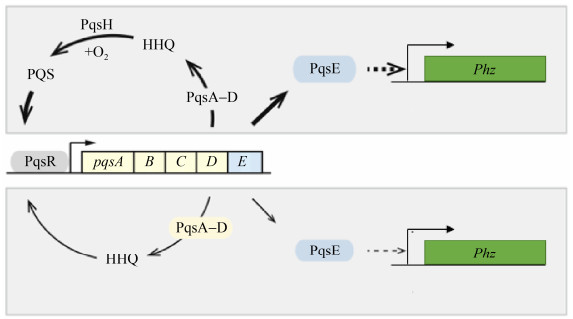
3.2 PQS群体感应系统PQS群体感应系统包含pqsABCDE操纵子及pqsH、pqsL这2个独立转录单元[54],pqsABCDE操纵子是生产喹酮类化学信号分子2-庚基-3-羟基-4-喹诺酮(2-heptyl-3-hydroxy- 4-quinolone,PQS)和2-庚基-3-羟基-4-喹啉(2-heptyl-3-hydroxy-4-quinoline,HHQ)所必需的,因为pqsABCD编码生产HHQ所需的生物合成酶。pqsH在基因组的其他地方编码,其产物是一种将HHQ转化为PQS的单加氧酶,HHQ和PQS都激活转录调节因子PqsR,PqsR本身激活了pqsABCDE的表达。因此,HHQ、PQS和PqsR都参与了一个自我调节的正反馈环(图 3)。在PQS群体感应系统中,参与吩嗪生物合成的PqsE蛋白是由pqsABCDE操纵子编码的,PqsE是一种金属水解酶[55],其可以促进Phz操纵子的表达,但具体机制还不清楚。
3.3 LasI/LasR和RhlI/RhlR群体感应系统在假单胞菌中LasI/LasR、RhlI/RhlR和PQS群体感应系统通常存在相关作用[56]。LasI/LasR系统[57]由LasR和LasI基因组成,LasI可以产生信号分子3-氧十二烷酰高丝氨酸内酯(3-oxo-C12-HSL),其可与LasR编码的蛋白形成复合物(LasR-3-oxo-C12-HSL)。LasR-3-oxo-C12-HSL可以激活PQS群体感应系统,因此促进了吩嗪的生物合成。同时LasR-3-oxo-C12-HSL复合物还可以激活RhlI/RhlR群体感应系统。RhlI/RhlR系统[58]由RhlI和RhlR基因组成,RhlI基因可以编码信号分子N-丁酰高丝氨酸环内酯(C4-HSL),其可与RhlR编码的蛋白形成复合物(RhlR-C4-HSL)。RhlR-C4-HSL复合物可抑制PQS群体感应系统中信号分子HHQ的产生,因此RhlI/RhlR群体感应系统可抑制吩嗪的生物合成。参与GacS/GacA调控吩嗪合成的转录调控因子RsmA,对群体感应LasI/LasR和RhlI/RhlR起到一定的抑制作用,因此GacS/GacA可通过LasI/LasR和RhlI/RhlR群体感应系统间接调控吩嗪合成。
吩嗪作为一种具有广谱抗菌活性的生物制剂,近些年在农业上的应用越来越受到认可。假单胞菌作为吩嗪合成的重要菌属,了解假单胞菌中吩嗪合成的机制具有重要意义。虽然目前对吩嗪合成机制的研究取得了一些进展,但关于吩嗪的研究仍需解决以下问题:
(1) 吩嗪的生产具有多样性,这样的多样性体现在不同物种、不同菌株甚至同一菌株在不同培养基中。尽管许多影响吩嗪生产的条件和调节因素已经确定,但是缺乏具体参数。阐明影响这一过程的具体参数将有助于吩嗪产量的提高。
(2) GacS/GacA作为一组全局性调控系统,其对吩嗪的合成有着十分重要的影响,可通过多种途径调控吩嗪的生物合成,但是激活GacS的信号尚未确定,因此确定激活GacS的环境信号将有助于完善吩嗪合成的调控机制。
(3) 在吩嗪生物合成的途径中,两分子DHHA缩合成PCA的具体机制还不清楚,今后的研究可以从这方面着手。
| [1] |
Zhu GF, Ying RR, Ye M, Zhang ST, Xia B, Qian JZ, Jiang X. Research progress on remediation technology of contaminated soil in pesticide production sites in China[J]. Chinese Journal of Soil Science, 2021, 52(2): 462-473. (in Chinese) 朱国繁, 应蓉蓉, 叶茂, 张胜田, 夏冰, 钱家忠, 蒋新. 我国农药生产场地污染土壤修复技术研究进展[J]. 土壤通报, 2021, 52(2): 462-473. |
| [2] |
Xue YH, Huang HK, Jin T, Chen S, Xu XB, Li SH, Bao Z, Ju XH, Xi B. Research progress on microplastic and pesticide pollutions and their toxic effects on soil organisms[J]. Journal of Agro-Environment Science, 2021, 40(2): 242-251. (in Chinese) 薛颖昊, 黄宏坤, 靳拓, 陈思, 徐湘博, 李少华, 宝哲, 居学海, 习斌. 土壤微塑料和农药污染及其对土壤动物毒性效应的研究进展[J]. 农业环境科学学报, 2021, 40(2): 242-251. |
| [3] |
Huang JS, Guo KX, You LJ. Present situation and control countermeasures of pesticide pollution in farmland soil in China[J]. South China Agriculture, 2019, 13(14): 165-166. (in Chinese) 黄佳盛, 郭凯先, 尤李俊. 中国农田土壤农药污染现状和防控对策[J]. 南方农业, 2019, 13(14): 165-166. |
| [4] |
Zhou M. The realistic challenge and countermeasure analysis of the development of biological pesticide in China[J]. Chinese Journal of Biological Control, 2021, 37(1): 184-192. (in Chinese) 周蒙. 中国生物农药发展的现实挑战与对策分析[J]. 中国生物防治学报, 2021, 37(1): 184-192. |
| [5] |
Zhang JL, Zhang JZ, Shen JB, Tian J, Jin KM, Zhang FS. Soil health and agriculture green development: opportunities and challenges[J]. Acta Pedologica Sinica, 2020, 57(4): 783-796. (in Chinese) 张俊伶, 张江周, 申建波, 田静, 金可默, 张福锁. 土壤健康与农业绿色发展: 机遇与对策[J]. 土壤学报, 2020, 57(4): 783-796. |
| [6] |
Zhu X, Wu QL, Li JK. Research progress of phenazine-1-carboxylic acid and its analogue[J]. Chinese Journal of Organic Chemistry, 2019, 39(10): 2744-2758. (in Chinese) 朱祥, 吴清来, 李俊凯. 吩嗪-1-羧酸及其类似物研究进展[J]. 有机化学, 2019, 39(10): 2744-2758. |
| [7] |
Williams P, Cámara M. Quorum sensing and environmental adaptation in Pseudomonas aeruginosa: a tale of regulatory networks and multifunctional signal molecules[J]. Current Opinion in Microbiology, 2009, 12(2): 182-191. DOI:10.1016/j.mib.2009.01.005 |
| [8] |
Mcrose DL, Newman DK. Redox-active antibiotics enhance phosphorus bioavailability[J]. Science, 2021, 371(6533): 1033-1037. DOI:10.1126/science.abd1515 |
| [9] |
Huang JF, Xu YQ, Zhang HY, Li YQ, Huang XQ, Ren B, Zhang XH. Temperature-dependent expression of phzM and its regulatory genes lasI and ptsP in rhizosphere isolate Pseudomonas sp. strain M18[J]. Applied and Environmental Microbiology, 2009, 75(20): 6568-6580. DOI:10.1128/AEM.01148-09 |
| [10] |
Sakhtah H, Price-Whelan A, Dietrich LEP. Regulation of Phenazine Biosynthesis[M]. Microbial Phenazines. Berlin, Heidelberg: Springer Berlin Heidelberg, 2013: 19-42.
|
| [11] |
Hou BW, Guo SQ, Peng HS, Zhang XH. Function of ompR gene in Pseudomonas aeruginosa HT66[J]. Microbiology China, 2018, 45(8): 1719-1725. (in Chinese) 侯博文, 郭树奇, 彭华松, 张雪洪. 绿针假单胞菌HT66中ompR基因的功能[J]. 微生物学通报, 2018, 45(8): 1719-1725. |
| [12] |
Chin-A-woeng TF, Thomas-Oates JE, Lugtenberg BJ, Bloemberg GV. Introduction of the phzH gene of Pseudomonas chlororaphis PCL1391 extends the range of biocontrol ability of phenazine-1-carboxylic acid-producing Pseudomonas spp. strains[J]. Molecular Plant Microbe Interactions, 2001, 14(8): 1006-1015. DOI:10.1094/MPMI.2001.14.8.1006 |
| [13] |
Turner JM, Messenger AJ. Occurrence, biochemistry and physiology of phenazine pigment production[J]. Advances in Microbial Physiology, 1986, 27: 211-275. |
| [14] |
Mavrodi DV, Thomashow LS, Blankenfeldt W. Biosynthesis and regulation of phenazine compounds in Pseudomonas spp. [A]//Pseudomonas[M]. Weinheim, Germany: Wiley-VCH Verlag GmbH & Co. KGaA, 2008: 331-351
|
| [15] |
Ma RT. The quorum sensing regulation and over-expression of phenazine biosynthetic gene cluster in Pseudomonas chlororaphis GP72[D]. Shanghai: Master's Thesis of Shanghai Jiaotong University, 2018 (in Chinese) 马润亭. 绿针假单胞菌GP72中吩嗪合成的群体感应调控与基因簇的过表达[D]. 上海: 上海交通大学硕士学位论文, 2018 |
| [16] |
Mavrodi DV, Ksenzenko VN, Bonsall RF, Cook RJ, Boronin AM, Thomashow LS. A seven-gene locus for synthesis of phenazine-1-carboxylic acid by Pseudomonas fluorescens 2-79[J]. Journal of Bacteriology, 1998, 180(9): 2541-2548. DOI:10.1128/JB.180.9.2541-2548.1998 |
| [17] |
Hu HB, Li YF, Liu KQ, Zhao J, Wang W, Zhang XH. Production of trans-2, 3-dihydro-3-hydroxyanthranilic acid by engineered Pseudomonas chlororaphis GP72[J]. Applied Microbiology and Biotechnology, 2017, 101(17): 6607-6613. DOI:10.1007/s00253-017-8408-0 |
| [18] |
Manuel M, Pratt T, Liu M, Jeffery G, Price DJ. Overexpression of Pax6 results in microphthalmia, retinal dysplasia and defective retinal ganglion cell axon guidance[J]. BMC Developmental Biology, 2008, 8(1): 59. DOI:10.1186/1471-213X-8-59 |
| [19] |
Galbraith MD, Giddens SR, Mahanty HK, Clark B. Role of glutamine synthetase in phenazine antibiotic production by Pantoea agglomerans Eh1087[J]. Canadian Journal of Microbiology, 2004, 50(10): 877-881. DOI:10.1139/w04-076 |
| [20] |
Li QY, Zhang DD, Wang SW, Sun T, Li TT, Li JR. Advances in molecular mechanisms of cold-adapting foodborne bacteria[J]. Food and Fermentation Industries, 2019, 45(5): 246-252. (in Chinese) 李秋莹, 张东栋, 王司雯, 孙彤, 李婷婷, 励建荣. 食源性细菌低温适应的分子机制研究进展[J]. 食品与发酵工业, 2019, 45(5): 246-252. |
| [21] |
Thomas L, Cook L. Two-component signal transduction systems in the human pathogen Streptococcus agalactiae[J]. Infection and Immunity, 2020, 88(7): 00931-19. |
| [22] |
Liu C, Sun D, Zhu JR, Liu WJ. Two-component signal transduction systems: a major strategy for connecting input stimuli to biofilm formation[J]. Frontiers in Microbiology, 2019, 9: 3279. DOI:10.3389/fmicb.2018.03279 |
| [23] |
Zhang SM, Li XF, Wang X, Li Z, He J. The two-component signal transduction system YvcPQ regulates the bacterial resistance to bacitracin in Bacillus thuringiensis[J]. Archives of Microbiology, 2016, 198(8): 773-784. DOI:10.1007/s00203-016-1239-z |
| [24] |
Zhang B, Zhang Y, Liang F, Ma YN, Wu XG. An extract produced by Bacillus sp. BR3 influences the function of the GacS/GacA two-component system in Pseudomonas syringae pv. tomato DC3000[J]. Frontiers in Microbiology, 2019, 10: 2005. DOI:10.3389/fmicb.2019.02005 |
| [25] |
O'Malley MR, Chien CF, Peck SC, Lin NC, Anderson JC. revised model for the role of GacS/GacA in regulating type Ⅲ secretion by Pseudomonas syringae pv. tomato DC3000[J]. Molecular Plant Pathology, 2020, 21(1): 139-144. DOI:10.1111/mpp.12876 |
| [26] |
Chancey ST, Wood DW, Pierson EA, Pierson LS. Survival of GacS/GacA mutants of the biological control bacterium Pseudomonas aureofaciens 30-84 in the wheat rhizosphere[J]. Applied and Environmental Microbiology, 2002, 68(7): 3308-3314. DOI:10.1128/AEM.68.7.3308-3314.2002 |
| [27] |
Lee JH, Ancona V, Zhao YF. Lon protease modulates virulence traits in Erwinia amylovora by direct monitoring of major regulators and indirectly through the Rcs and Gac-Csr regulatory systems[J]. Molecular Plant Pathology, 2018, 19(4): 827-840. DOI:10.1111/mpp.12566 |
| [28] |
Hrabak EM, Willis DK. The lemA gene required for pathogenicity of Pseudomonas syringae pv. syringae on bean is a member of a family of two-component regulators[J]. Journal of Bacteriology, 1992, 174(9): 3011-3020. DOI:10.1128/jb.174.9.3011-3020.1992 |
| [29] |
Heeb S, Haas D. Regulatory roles of the GacS/GacA two-component system in plant-associated and other Gram-negative bacteria[J]. Molecular Plant Microbe Interactions, 2001, 14(12): 1351-63. DOI:10.1094/MPMI.2001.14.12.1351 |
| [30] |
Zhang Y, Zhang B, Wu H, Wu XG, Yan Q, Zhang LQ. Pleiotropic effects of RsmA and RsmE proteins in Pseudomonas fluorescens 2P24[J]. BMC Microbiology, 2020, 20(1): 307-319. DOI:10.1186/s12866-020-01997-z |
| [31] |
Jimenez PN, Koch G, Thompson JA, Xavier KB, Cool RH, Quax WJ. The multiple signaling systems regulating virulence in Pseudomonas aeruginosa[J]. Microbiology and Molecular Biology Reviews, 2012, 76(1): 46-65. DOI:10.1128/MMBR.05007-11 |
| [32] |
Novovic KD, Malesevic MJ, Filipic BV, Mirkovic NL, Miljkovic MS, Kojic MO, Jovčić BU. PsrA regulator connects cell physiology and class 1 integron integrase gene expression through the regulation of lexA gene expression in Pseudomonas spp.[J]. Current Microbiology, 2019, 76(3): 320-328. DOI:10.1007/s00284-019-01626-7 |
| [33] |
Zhang C, Wang C, Jatt AN, Liu H, Liu Y. Role of RpoS in stress resistance, biofilm formation and quorum sensing of Shewanella baltica[J]. Letters in Applied Microbiology, 2021, 72(3): 307-315. DOI:10.1111/lam.13424 |
| [34] |
Yu JM, Wang DP, Pierson LS, Pierson EA. Disruption of MiaA provides insights into the regulation of phenazine biosynthesis under suboptimal growth conditions in Pseudomonas chlororaphis 30-84[J]. Microbiology: Reading, England, 2017, 163(1): 94-108. DOI:10.1099/mic.0.000409 |
| [35] |
Girard G, Rij ETV, Lugtenberg BJJ, Bloemberg GV. Regulatory roles of psrA and rpoS in phenazine-1-carboxamide synthesis by Pseudomonas chlororaphis PCL1391[J]. Microbiology, 2006, 152(1): 43-58. DOI:10.1099/mic.0.28284-0 |
| [36] |
Latifi A, Foglino M, Tanaka K, Williams P, Lazdunski A. A hierarchical quorum-sensing cascade in Pseudomonas aeruginosa links the transcriptional activators LasR and RhIR (VsmR) to expression of the stationary-phase sigma factor RpoS[J]. Molecular Microbiology, 1996, 21(6): 1137-1146. DOI:10.1046/j.1365-2958.1996.00063.x |
| [37] |
Wang DP, Yu JM, Pierson LS, Pierson EA. Differential regulation of phenazine biosynthesis by RpeA and RpeB in Pseudomonas chlororaphis 30-84[J]. Microbiology, 2012, 158(7): 1745-1757. DOI:10.1099/mic.0.059352-0 |
| [38] |
Whistler CA, Pierson LS. Repression of phenazine antibiotic production in Pseudomonas aureofaciens strain 30-84 by RpeA[J]. Journal of Bacteriology, 2003, 185(13): 3718-25. DOI:10.1128/JB.185.13.3718-3725.2003 |
| [39] |
Chen MM. Study on the biosynthesis mechnism of 2-hydroxy-phenazine and the two-component system RpeA/RpeB in Pseudomonas chlororaphis GP72[D]. Shanghai: Doctoral Dissertation of Shanghai Jiaotong University, 2016 (in Chinese) 陈明敏. 绿针假单胞菌GP72中2-羟基-吩嗪的合成机理及其双组分调控系统RpeA/RpeB的研究[D]. 上海: 上海交通大学博士学位论文, 2016 |
| [40] |
Petrova OE, Sauer K. The novel two-component regulatory system BfiSR regulates biofilm development by controlling the small RNA rsmZ through CafA[J]. Journal of Bacteriology, 2010, 192(20): 5275-5288. DOI:10.1128/JB.00387-10 |
| [41] |
Dai SX, Han YL, Yan YL, Lin M, Ping SZ. Research progress on CbrA-CbrB two-component system in Pseudomonas[J]. Current Biotechnology, 2012, 2(2): 98-103. (in Chinese) 代淑贤, 韩云蕾, 燕永亮, 林敏, 平淑珍. 假单胞菌中CbrA-CbrB二元调控系统的研究进展[J]. 生物技术进展, 2012, 2(2): 98-103. DOI:10.3969/j.issn.2095-2341.2012.02.04 |
| [42] |
Sonnleitner E, Abdou L, Haas D. Small RNA as global regulator of carbon catabolite repression in Pseudomonas aeruginosa[J]. Proceedings of the National Academy of Sciences, 2009, 106(51): 21866-21871. DOI:10.1073/pnas.0910308106 |
| [43] |
Mavrodi DV, Bonsall RF, Delaney SM, Soule MJ, Phillips G, Thomashow LS. Functional analysis of genes for biosynthesis of pyocyanin and phenazine-1-carboxamide from Pseudomonas aeruginosa PAO1[J]. Journal of Bacteriology, 2001, 183(21): 6454-6465. DOI:10.1128/JB.183.21.6454-6465.2001 |
| [44] |
Dieppois G, Ducret V, Caille O, Perron K. The transcriptional regulator CzcR modulates antibiotic resistance and quorum sensing in Pseudomonas aeruginosa[J]. PLoS One, 2012, 7(5): e38148. DOI:10.1371/journal.pone.0038148 |
| [45] |
Withers H, Swift S, Williams P. Quorum sensing as an integral component of gene regulatory networks in Gram-negative bacteria[J]. Current Opinion in Microbiology, 2001, 4(2): 186-193. DOI:10.1016/S1369-5274(00)00187-9 |
| [46] |
Anton H. Quorum sensing N-acyl-homoserine lactone signal molecules of plant beneficial Gram-negative rhizobacteria support plant growth and resistance to pathogens[J]. Rhizosphere, 2020, 16: 100258. DOI:10.1016/j.rhisph.2020.100258 |
| [47] |
Zhao ZC, Xie GJ, Liu BF, Xing DF, Ding J, Han HJ, Ren NQ. A review of quorum sensing improving partial nitritation-anammox process: functions, mechanisms and prospects[J]. Science of the Total Environment, 2021, 765: 142703. DOI:10.1016/j.scitotenv.2020.142703 |
| [48] |
Ge JP, Fang BZ, Yuan TT, Ping WX. Quorum-sensing behavior of Lactobacillus paracasei HD1.7[J]. Acta Microbiologica Sinica, 2011, 51(11): 1561-1567. (in Chinese) 葛菁萍, 房保柱, 苑婷婷, 平文祥. 副干酪乳杆菌HD1.7群体感应行为[J]. 微生物学报, 2011, 51(11): 1561-1567. |
| [49] |
Ge JP, Ping WX, Song G, Du CM, Ling HZ, Sun X, Gao Y. Paracin 1.7, a bacteriocin produced by Lactobacillus paracasei HD1.7 isolated from Chinese cabbage sauerkraut, a traditional Chinese fermented vegetable food[J]. Acta Microbiologica Sinica, 2009, 49(5): 610-617. |
| [50] |
Ge JP, Kang J, Ping WX. Effect of acetic acid on bacteriocin production by Gram-positive bacteria[J]. Journal of Microbiology and Biotechnology, 2019, 29(9): 1341-1348. DOI:10.4014/jmb.1905.05060 |
| [51] |
Fuqua C, Parsek MR, Greenberg EP. Regulation of gene expression by cell-to-cell communication: acyl-homoserine lactone quorum sensing[J]. Annual Review of Genetics, 2001, 35: 439-468. DOI:10.1146/annurev.genet.35.102401.090913 |
| [52] |
Yu JM, Wang DP, Ries TR, Pierson LS, Pierson EA. An upstream sequence modulates phenazine production at the level of transcription and translation in the biological control strain Pseudomonas chlororaphis 30-84[J]. PLoS One, 2018, 13(2): e0193063. DOI:10.1371/journal.pone.0193063 |
| [53] |
Chancey ST, Wood DW, Pierson LS. Two-component transcriptional regulation of N-acyl-homoserine lactone production in Pseudomonas aureofaciens[J]. Applied and Environmental Microbiology, 1999, 65(6): 2294-2299. DOI:10.1128/AEM.65.6.2294-2299.1999 |
| [54] |
Valerio B, Francesca D, Viola P, Vita FE, Paolo V, Giordano R, Livia L. Identification of FDA-approved antivirulence drugs targeting the Pseudomonas aeruginosa quorum sensing effector protein PqsE[J]. Virulence, 2020, 11(1): 652-668. DOI:10.1080/21505594.2020.1770508 |
| [55] |
Déziel E, Lépine F, Milot S, He JX, Mindrinos MN, Tompkins RG, Rahme LG. Analysis of Pseudomonas aeruginosa 4-hydroxy-2-alkylquinolines (HAQs) reveals a role for 4-hydroxy-2-heptylquinoline in cell-to-cell communication[J]. Proceedings of the National Academy of Sciences of the United States of America, 2004, 101(5): 1339-1344. DOI:10.1073/pnas.0307694100 |
| [56] |
Abbas HAM, Soliman WEE, Shaldam MA. Perturbation of quorum sensing in Pseudomonas aeruginosa by febuxostat[J]. Advances in Microbiology, 2018, 8(8): 650-664. DOI:10.4236/aim.2018.88044 |
| [57] |
Morales E, González-Valdez A, Servín-González L, Soberón-Chávez G. Pseudomonas aeruginosa quorum-sensing response in the absence of functional LasR and LasI proteins: the case of strain 148, a virulent dolphin isolate[J]. FEMS Microbiology Letters, 2017, 364(12): 119. |
| [58] |
Haller S, Franchet A, Hakkim A, Chen J, Drenkard E, Yu S, Schirmeier S, Li Z, Martins N, Ausubel FM, et al. Quorum-sensing regulator RhlR but not its autoinducer RhlI enables Pseudomonas to evade opsonization[J]. EMBO Reports, 2018, 19(5): e44880. |